

Bangladesh Textile Industry: Garment industries and Future Challenges
Why do so many foreign buyers continue to source garments from the Bangladesh textile industry year after year, even as global supply chains become more competitive and complex? The short answer is that Bangladesh offers a rare combination of scale, experience, export focus, and supplier depth that few sourcing destinations can match at the same price-performance level. Bangladesh’s apparel exports reached about $38.48 billion in 2024, according to BGMEA’s export performance data, which shows how central the garment sector remains to the country’s trade profile.
For foreign buyers, though, an industry overview needs to go beyond export size. The real questions are practical. What product categories is Bangladesh strongest in? How reliable is the supply chain? What should buyers expect in terms of capacity, compliance, sustainability, communication, and sourcing risk? These are the issues that matter when choosing a country for private label production, wholesale sourcing, retail programs, or long-term apparel manufacturing partnerships. Bangladesh is especially significant because it already serves major end markets at scale. The WTO notes that in 2024, around 40 percent of Bangladesh’s ready-made garment exports went to the European Union and another 18 percent went to the United States.
Bangladesh’s garment sector is also unusually important to the wider economy. The World Bank and related policy materials describe ready-made garments as the dominant force in Bangladesh’s exports, with apparel accounting for roughly 82 to 85 percent of the country’s export earnings in recent years, depending on the source and time frame. Bangladesh’s own Export Policy 2024-27 calls the RMG sector the foundation for industrialization, GDP and export growth, and employment.
That matters to foreign buyers because it means Bangladesh is not a side-market for apparel. It is one of the country’s core industrial systems. Government policy, trade institutions, factory investment, and buyer relationships are all heavily tied to garments. For a sourcing market, that concentration has both strengths and risks, but it undeniably creates depth. BGMEA says Bangladesh has 35+ years of experience in apparel manufacturing and 4,000+ factories serving major global fashion brands.
This guide is designed for foreign buyers who want a practical understanding of the Bangladesh garment industry. It covers what the sector looks like today, why buyers choose it, what product categories dominate, where sustainability and compliance stand, what risks still exist, and how to evaluate Bangladesh suppliers more effectively.
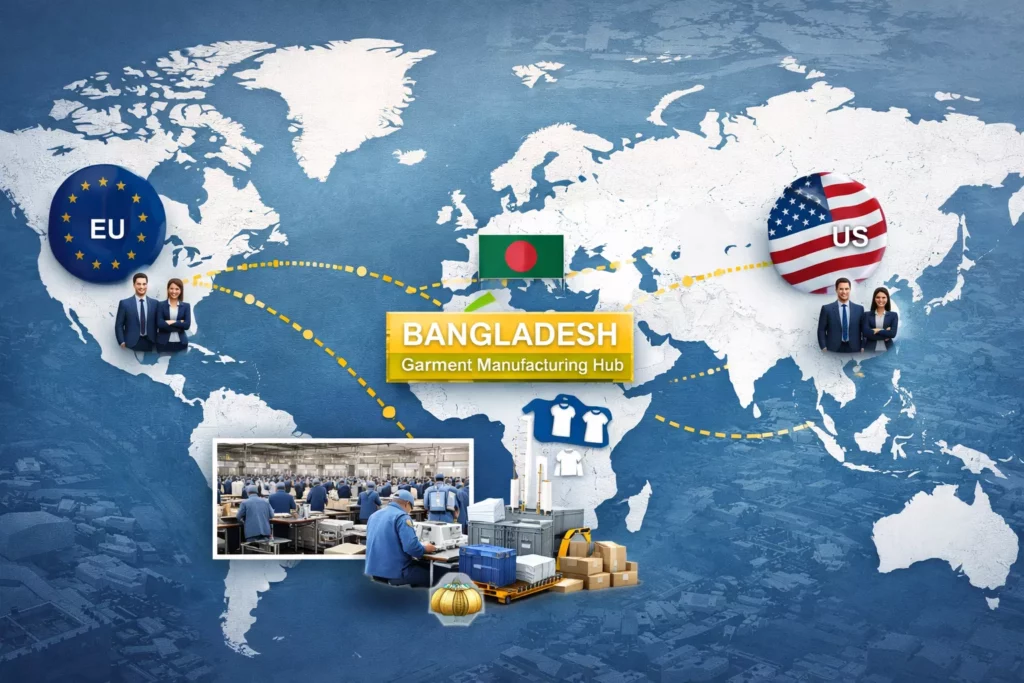
Bangladesh Readymade Garment Industry(RMG) at a Glance
Before exploring the details of the sector, it helps foreign buyers understand the overall scale and importance of Bangladesh’s garment industry.
The ready-made garment (RMG) sector is the backbone of Bangladesh’s export economy and one of the largest apparel manufacturing ecosystems in the world. Over the past three decades, the country has developed an extensive network of garment factories, textile suppliers, export logistics providers, and compliance systems that support international fashion brands.
Some key facts about the Bangladesh garment industry include:
- More than 4,000 export-oriented garment factories
- Approximately 4 million workers employed in the apparel sector
- One of the world’s largest apparel exporters
- Apparel exports exceed $38 billion annually
- Strong trade relationships with the European Union and the United States
- Hundreds of internationally certified green garment factories
Because of this scale and infrastructure, Bangladesh continues to play a critical role in global apparel supply chains for retailers, private label brands, and sourcing companies worldwide.
History of textile production in Bangladesh
The modern history of the textile industry in Bangladesh traces a shift from the traditional jute sector to the country’s early prominence in fibers toward a dominant ready-made garment industry and textile and clothing industry. The rise of the garment industry in Bangladesh transformed the sector to the country’s economy, creating an export industry with exports from Bangladesh led by the garment industry’s producers and the Bangladesh garment manufacturers and exporters association and the garment manufacturers and exporters association.
Despite growth in the apparel sector and the manufacturing industry, garment workers, including millions of women garment workers and female workers, face challenges in working conditions, workplace safety and working environment. High-profile tragedies like Rana Plaza exposed poor building safety in Bangladesh. Calls from the alliance for Bangladesh and international buyers pushed reforms in export processing, minimum wage debates and measures to protect garment workers in Bangladesh. Today the rmg industry and the garment industry of Bangladesh employ an estimated 3 million workers out of a number of workers in the country, supporting a global market for textiles and clothing while confronting issues of low wage labor and the role of the government of Bangladesh in regulation.
Is The Bangladesh Garment Industry Overview Good
The Bangladesh textile and apparel sector remains pivotal to the economic development of Bangladesh, employing a garment workforce of about four million workers, many of them women workers, and serving as a major source of foreign exchange through the exports of textiles and garments.
As the world’s second largest exporter of garments, Bangladesh often supplies international brands and clothing brands across Europe and North America and plays a significant role in the global and global textile and global clothing market, producing a billion worth of products annually in Bangladeshi factories.
However, challenges persist: dependence on private garment units, persistent low pay, and the legacy of the Rana Plaza tragedy remind stakeholders that while countries like Bangladesh have transformed into a garment hub, sustainable improvement is still essential.
Bangladesh’s Position in the Global Apparel Market
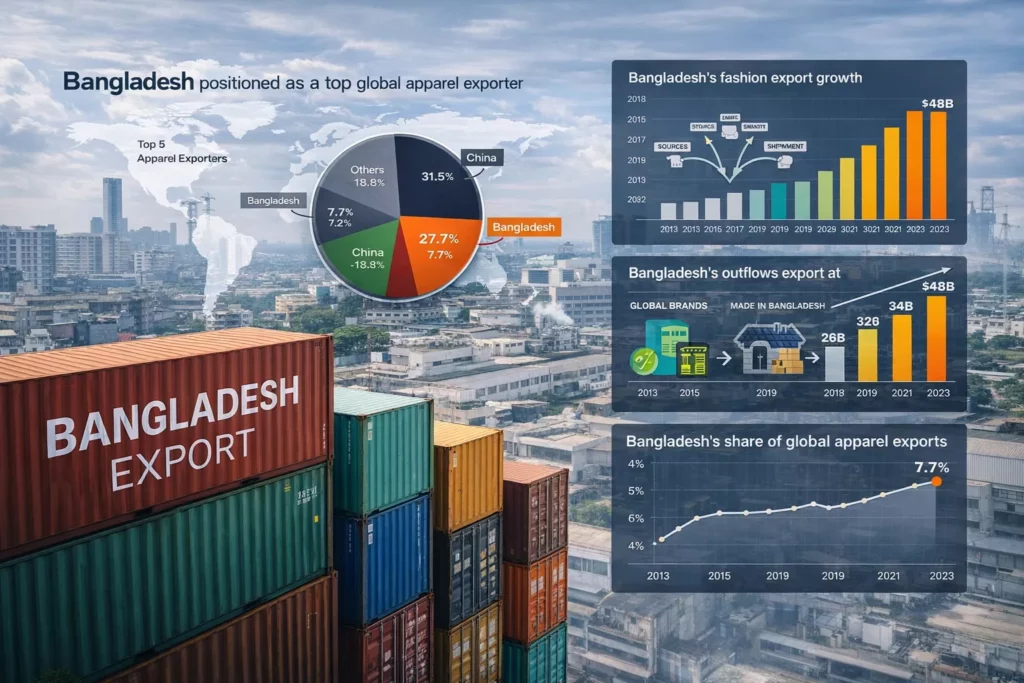
Bangladesh is not just an important regional supplier. It is one of the world’s leading garment exporters. BGMEA’s 2024 export figures place the country’s apparel export value at about $38.48 billion, while IFC’s 2025 Bangladesh diagnostic describes Bangladesh as the world’s second-largest exporter of textiles, after China. Recent trade reporting has also continued to describe Bangladesh as holding the number two position in global apparel exports.
For foreign buyers, that global standing matters because scale usually signals reliability of infrastructure, not perfection, but maturity. Countries do not stay near the top of global garment exports unless they can repeatedly support fabric sourcing, bulk manufacturing, quality control, shipment preparation, and international customer requirements. Bangladesh has done that for decades, especially in price-sensitive and volume-heavy categories. BGMEA’s own homepage frames the industry as a 35+ year export platform serving major global brands.
Another important point is market concentration. Bangladesh’s garment trade is deeply tied to large buying regions. The EU is Bangladesh’s largest trade partner, and the European Commission states that textiles accounted for almost 94 percent of the EU’s total imports from Bangladesh in 2024. For buyers, this shows how heavily international apparel demand is already integrated into Bangladesh’s export model.
That global integration gives buyers a degree of comfort. It means Bangladesh suppliers are generally familiar with export documentation, packaging standards, compliance expectations, and retailer requirements from some of the world’s most demanding consumer markets. A foreign buyer entering Bangladesh is not entering an untested supply environment. They are entering one of the most established garment export ecosystems in the world.
Education in the Bangladeshi Textile Sector
Education in the Bangladeshi garment sector is pivotal for sustaining a billion worth exports from Bangladesh and diversifying from the jute sector to the country’s broader economy; partnerships like the Alliance for Bangladesh support training that raises safety measures and builds managerial skills across the RMG industry. Investment in technical and vocational programs strengthens garment manufacturing in Bangladesh, helping garment factories in Bangladesh meet international standards while improving the overall working environment.
Targeted education empowers women garment workers and female workers, who form the backbone of the garment industry’s workforce, and helps garment workers in Bangladesh access higher-paying roles with better benefits and better working conditions. Collaboration between the Bangladesh garment manufacturers and exporters, the garment manufacturers and exporters association, and public institutions ensures curriculum relevance for the manufacturing industry, aligns with quota changes, and supports building safety in Bangladesh to protect livelihoods and long-term growth.
How Big the Industry Really Is
One of the biggest advantages for foreign buyers is that Bangladesh’s garment industry operates at true industrial scale. BGMEA reports 4,000+ factories, while official export data shows annual apparel export values that have stayed in the tens of billions of dollars for years. On a calendar-year basis, BGMEA lists apparel exports at $45.71 billion in 2022, $35.89 billion in 2023, and $38.48 billion in 2024.
The workforce scale is also substantial. WTO-related material and other recent reporting describe the sector as employing around 4 million people, with women forming a large share of the workforce. That workforce depth is one reason Bangladesh can support very large production programs that would be difficult to place in smaller sourcing markets.
For foreign buyers, industry size translates into practical sourcing flexibility. There are large factories for bulk programs, specialized units for particular product categories, vertically integrated groups, and a wide range of support vendors for trims, packaging, washing, embroidery, and logistics. This does not mean every supplier is suitable for every buyer, but it does mean the market is broad enough to support both mass programs and more selective sourcing strategies. BGMEA’s trade information and export tables also show consistent specialization in core product groups over time, which reinforces the idea of stable industrial depth rather than random growth.
Buyers should also understand that Bangladesh’s garment industry is deeply export-oriented. This is not primarily a domestic fashion manufacturing sector with exports on the side. The scale, systems, and factory investments have largely been built around foreign demand. That gives international buyers a stronger fit than they might find in markets where export garment production is less central.
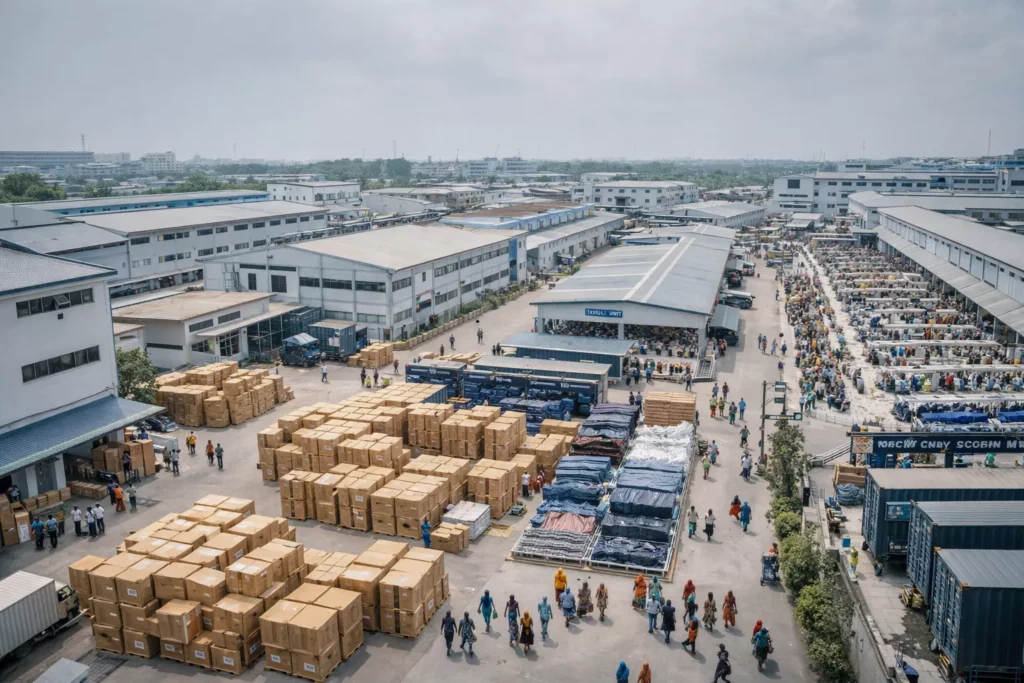
Main Product Categories Foreign Buyers Source from Bangladesh
Bangladesh is strongest where industrial repetition, category experience, and bulk efficiency matter. BGMEA’s export tables show major apparel items including trousers, T-shirts and knitted shirts, sweaters, shirts and blouses, and underwear among the leading export categories. These are not small sidelines. They are core pillars of the country’s export mix.
For foreign buyers, this category concentration is helpful because it points to where supplier experience is deepest. Bangladesh is particularly well known for knitwear, casual bottoms, sweaters, denim-related items, schoolwear, uniforms, and large-volume basics. Buyers sourcing cotton-rich or price-sensitive programs often find Bangladesh especially competitive because so many factories have built their systems around those exact product families.
This does not mean Bangladesh is limited to basics only. IFC’s 2025 private sector diagnostic notes that the country is trying to move further into higher-value products and man-made fiber segments as global demand changes. That means foreign buyers can expect increasing capability in more complex or diversified categories, although category strength still varies by supplier. In practice, Bangladesh remains strongest when buyers align their product mix with supplier specialization rather than assuming every factory can do everything equally well.
A foreign buyer approaching the market should therefore think in category terms first. If the program is built around high-volume knitwear, trousers, sweaters, core woven tops, or repeat retail basics, Bangladesh is often a very strong fit. If the program is highly technical, fiber-specific, or dependent on niche materials, supplier screening becomes even more important.
Why Foreign Buyers Choose Bangladesh
Foreign buyers usually choose Bangladesh for a combination of reasons rather than one single advantage. Cost still matters, but it is not the whole story. Bangladesh remains attractive because it combines competitive production economics with industrial scale, category familiarity, and strong export orientation. BGMEA’s scale data, WTO market access figures, and IFC’s sector analysis all support this overall picture.
One major reason is volume capability. Bangladesh is particularly valuable when buyers need consistent execution across large order quantities. Another is supplier familiarity with international buyers. Because the sector has worked with overseas brands for decades, many suppliers understand tech packs, inspection requirements, packaging specifications, and shipment documentation better than factories in less export-focused markets.
A third reason is supplier ecosystem density. In Bangladesh, garment manufacturing is supported by a wide network of related services, from washing and embroidery to packaging and logistics. This ecosystem helps buyers manage more of the production process within one sourcing environment. A fourth reason is sustainability momentum. BGMEA reported 258 LEED-certified green factories in August 2025, and more recent reporting has indicated the number rose further. Even using the conservative official BGMEA figure, Bangladesh clearly stands out in green apparel manufacturing.
The final reason is commercial familiarity. Bangladesh already supplies the EU and US at large scale, which means many buyers are entering a sourcing market that already understands their compliance and delivery expectations. That reduces entry friction compared with trying to build a new sourcing base from scratch in a less mature market.
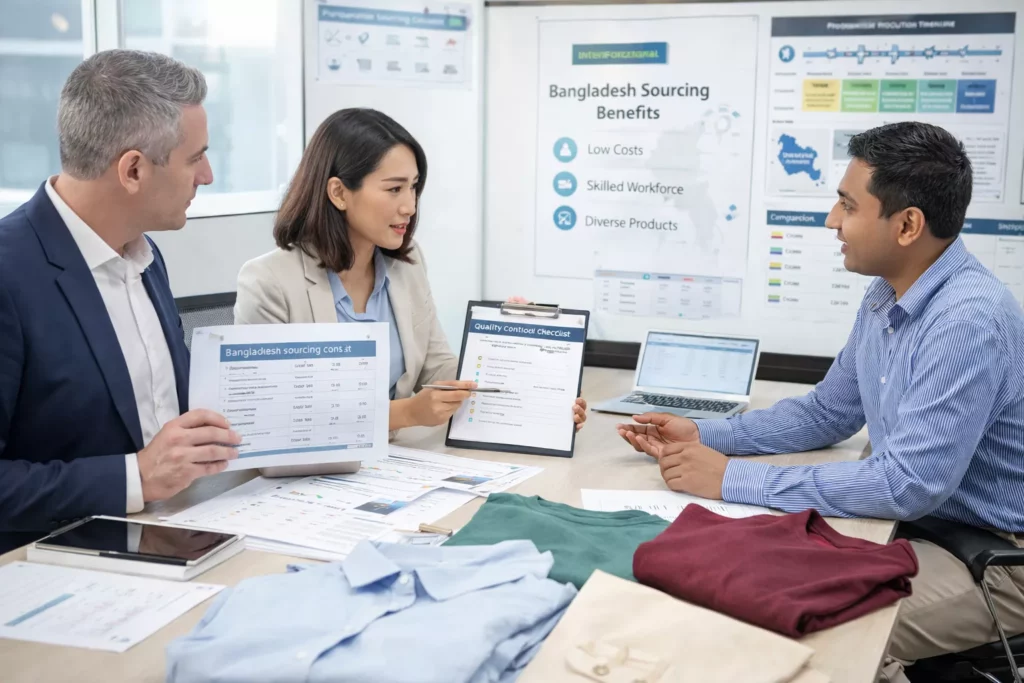
Key Sourcing Advantages for Foreign Buyers
For international apparel buyers, Bangladesh offers several practical advantages that support large-scale sourcing programs. These advantages go beyond production costs and include operational strengths that make the country a dependable manufacturing partner.
Production Scale
Bangladesh is known for its ability to handle large apparel orders. Many factories are structured to produce high volumes efficiently, which is ideal for retailers and brands that require a consistent supply.
Experienced Export Manufacturers
Because the garment industry has been exporting clothing for decades, many factories are familiar with international buyer requirements, including tech packs, compliance documentation, labeling standards, and packaging specifications.
Strong Manufacturing Ecosystem
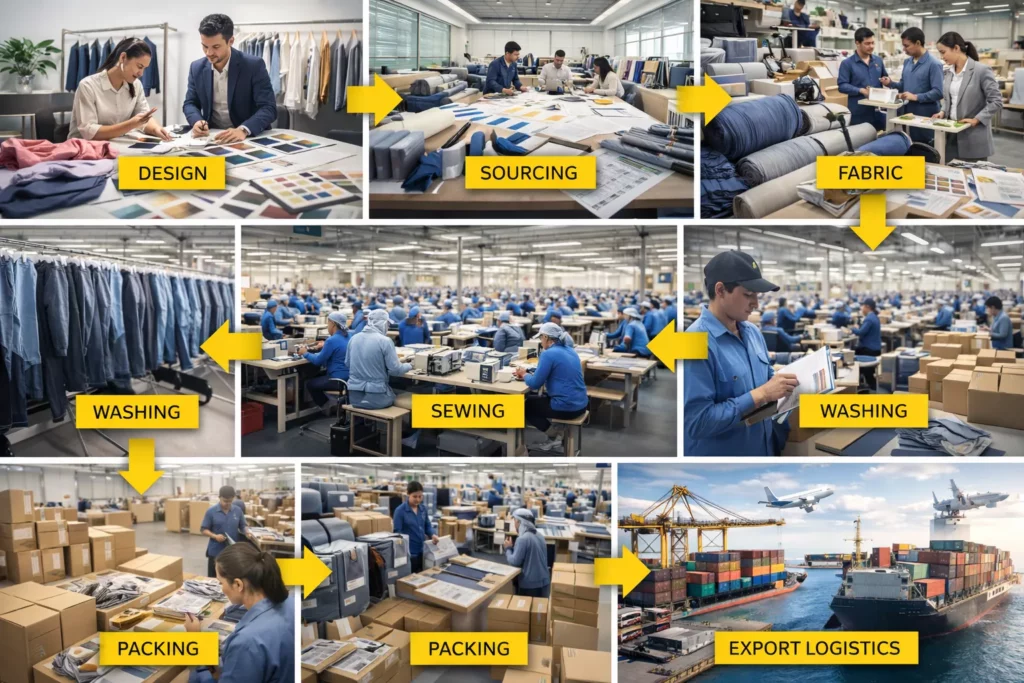
In addition to garment factories, Bangladesh offers a wide network of supporting services such as fabric sourcing, washing facilities, embroidery units, printing houses, packaging suppliers, and logistics providers.
Competitive Cost Structure
The country remains one of the most competitive sourcing destinations for bulk apparel production, particularly for cotton-based garments and casualwear.
Growing Sustainability Investment
Bangladesh is home to a large number of green garment factories that focus on energy efficiency, water management, and responsible manufacturing practices.
Together, these advantages make Bangladesh a strategic sourcing destination for many international apparel buyers.
Industry Structure: From Factory Floor to Export Chain
Foreign buyers often benefit from understanding how the Bangladesh garment industry is structurally organized. At the center are export-oriented garment factories, ranging from medium-sized cut-make-trim operations to larger vertically integrated groups that handle knitting, dyeing, sewing, finishing, washing, and packaging under one umbrella. IFC project materials and sector diagnostics highlight these integrated capabilities as part of the country’s investment appeal.
Around those factories sits a broader support system. Buyers will encounter mills, trims suppliers, embroidery vendors, printing facilities, washing units, compliance auditors, testing services, packaging providers, freight forwarders, and buying-house style intermediaries. This matters because Bangladesh sourcing is rarely about just placing an order with one sewing line. The real performance of a supplier often depends on how well they coordinate this wider network.
There is also a difference between direct factory sourcing and intermediary-led sourcing. Some foreign buyers work directly with manufacturers. Others rely on agents, sourcing offices, or manufacturing partners that manage development, approvals, and quality follow-up. In Bangladesh, both models exist, and the right choice usually depends on buyer size, technical capability, and the complexity of the product program. The size and diversity of the market make this flexibility possible.
For new foreign buyers, the key takeaway is that Bangladesh is not a one-shape industry. There are highly organized suppliers, less organized suppliers, specialist product factories, and broad-scale manufacturing groups. The market is large enough to offer options, but that also means factory evaluation matters a great deal.
Compliance, Safety, and Sustainability
No serious industry overview for foreign buyers can ignore compliance and safety. Bangladesh’s garment sector was permanently reshaped by safety failures in the past, but the post-crisis reform era has also become one of the defining features of the industry. The International Accord continues to operate in Bangladesh, with systems for health and safety oversight and public remediation tracking. That ongoing structure is important for buyer confidence.
Sustainability is another major point. BGMEA’s official August 2025 announcement put the number of LEED-certified green factories at 258, a figure that reinforces Bangladesh’s leadership in green garment manufacturing. IFC’s 2025 Bangladesh diagnostic also identifies Green Ready-Made Garments as one of the country’s key investment opportunities, showing that sustainability is not only a marketing message but part of the sector’s future growth strategy.
For foreign buyers, these developments matter in practical ways. A market with stronger factory safety systems and a growing base of green buildings can better support retailer ESG goals, investor expectations, and compliance screening. Still, buyers should not generalize too broadly. Country-level progress does not replace factory-level due diligence. Bangladesh has many strong factories, but supplier standards still vary, and every buyer should review compliance documentation, production systems, and quality control practices before committing.
The balanced view is this: Bangladesh has made meaningful progress in both safety and sustainability, and that progress is now one of the industry’s real strengths. But responsible sourcing still depends on choosing the right factory, not just the right country.
Trade Access and Why It Matters to Buyers
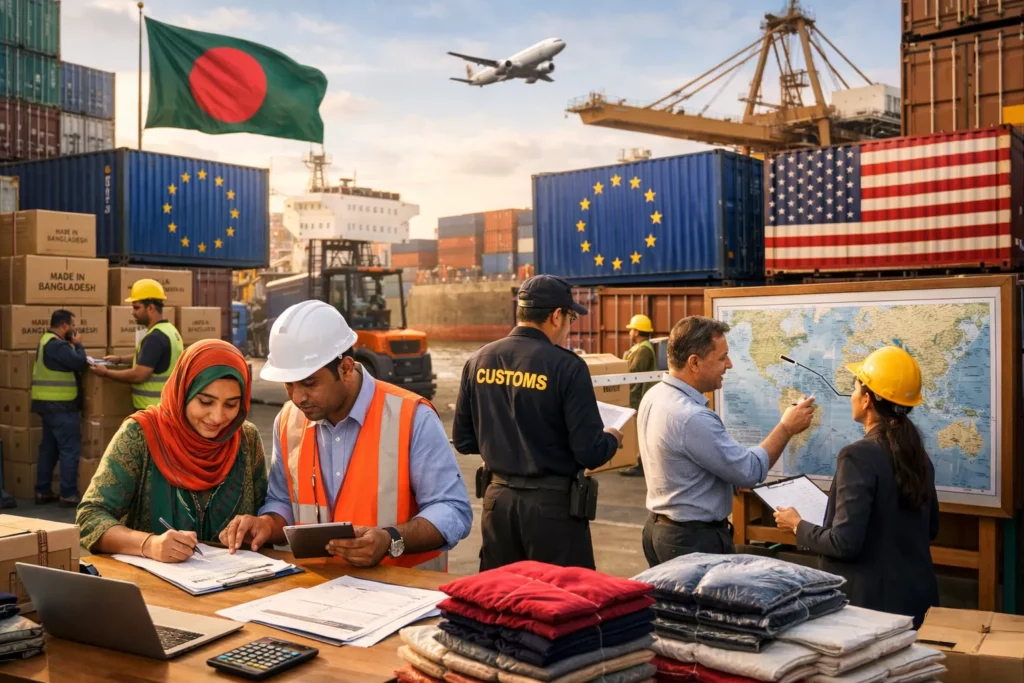
Bangladesh’s trade positioning is another important piece of the puzzle for foreign buyers. The country’s garment exports are heavily tied to the European Union and the United States, which means suppliers are already familiar with the standards of the world’s largest apparel-buying markets. WTO notes that around 40 percent of Bangladesh’s RMG exports went to the EU in 2024 and 18 percent to the US. The European Commission separately notes that textiles made up almost 94 percent of EU imports from Bangladesh in 2024.
This matters commercially because foreign buyers often prefer to source from markets that already operate within their target trade routes. It affects shipping routines, documentation systems, testing expectations, labeling standards, and supplier familiarity with retailer compliance processes. Bangladesh is already deeply embedded in those flows.
At the same time, foreign buyers should keep an eye on policy changes. Trade terms, tariffs, LDC graduation issues, and logistics shifts can affect the cost structure of sourcing from Bangladesh over time. Recent Reuters reporting also shows how trade negotiations and tariff changes can materially affect Bangladesh’s apparel competitiveness in major markets. Buyers do not need to panic, but they do need to stay commercially aware.
So the opportunity is clear, but so is the need for active market awareness. Bangladesh is highly relevant because of its established trade connections, yet foreign buyers should still monitor policy and logistics developments as part of long-term sourcing strategy.
Risks and Challenges Foreign Buyers Should Understand
A useful industry overview should not sound like pure promotion. Bangladesh has major strengths, but foreign buyers should also understand the structural challenges. One major issue is concentration risk. Because garments account for such a large share of exports, the sector can be vulnerable to global demand shifts, trade policy changes, and external disruptions. The World Bank and other policy sources have noted this dependence clearly.
Another challenge is product upgrading. IFC’s 2025 diagnostic stresses the need for more advanced technologies and stronger man-made fiber capability if Bangladesh wants to keep pace with changes in global apparel demand. This does not weaken the country’s current role in basics and core categories, but it does mean buyers with more technical product needs should screen suppliers carefully rather than assuming market-wide readiness.
Logistics and raw material dependence can also create pressure. Reuters coverage in 2025 highlighted how disruptions in cargo infrastructure can directly affect garment exports, product samples, and shipment timing. Other trade developments, such as regional transit changes, can also influence cost and lead-time planning.
Then there is the basic sourcing reality that not all factories perform at the same level. Bangladesh’s size is an advantage, but it also means quality systems, communication, capacity planning, and compliance maturity vary widely across suppliers. For foreign buyers, the biggest risk is often not “Bangladesh” as a market. It is choosing a supplier that is not aligned with the product, timeline, and quality requirement.
What Foreign Buyers Should Look for in Bangladesh Suppliers
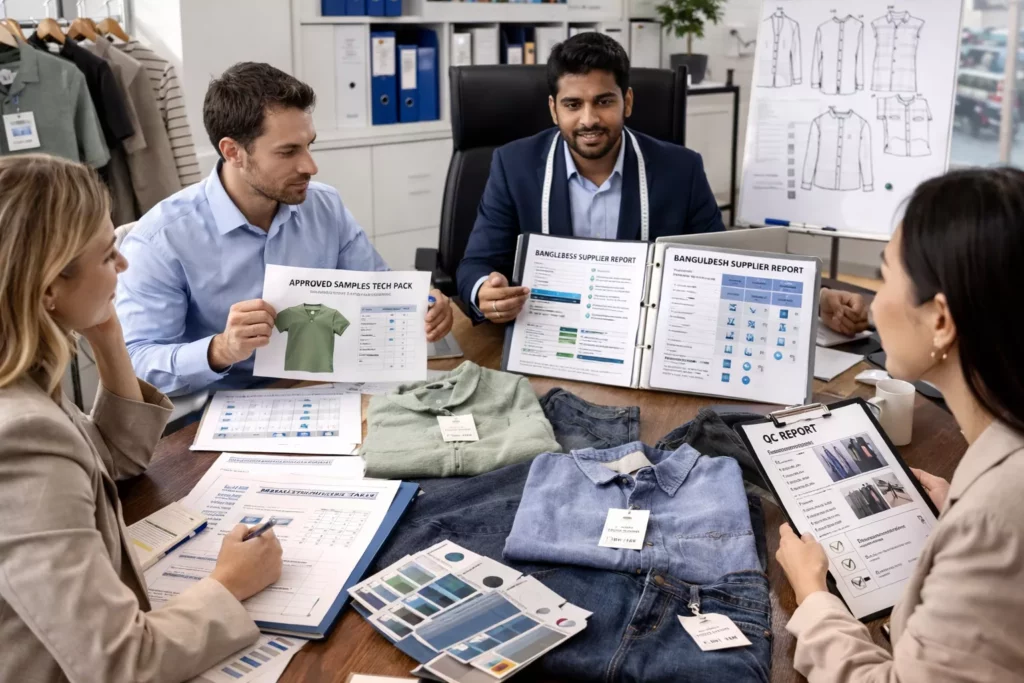
Once a buyer decides Bangladesh is a serious sourcing option, the next step is supplier evaluation. The first thing to assess is product-category fit. A supplier that is excellent at knit basics may not be ideal for tailored woven pieces or complex technical products. Bangladesh is strong overall, but factory specialization matters a lot.
The second thing is technical execution. Buyers should review sample quality, measurement accuracy, stitch consistency, construction detail, and how clearly the supplier interprets tech packs. The third is process discipline. Strong suppliers usually show clear pre-production planning, inline quality control, and a structured approval flow. The fourth is communication. Because Bangladesh is such a large market, buyers will see big differences in responsiveness and reporting quality from one supplier to another. These are supplier-level factors, but they directly shape sourcing outcomes. While these evaluation points are partly practical judgment rather than statistics, they align with the market realities reflected in BGMEA’s scale and trade data and IFC’s emphasis on competitiveness and upgrading.
Compliance documentation and sustainability capacity are also increasingly important. Buyers targeting large retail chains or ESG-sensitive markets should verify not just certifications but also working systems, including audit readiness, remediation history, and production-floor organization. Bangladesh offers many strong options here, but verification remains essential.
In other words, the best Bangladesh suppliers are usually the ones that combine category strength, process discipline, and transparent communication, not simply the ones with the lowest price.
Bangladesh for Different Types of Foreign Buyers
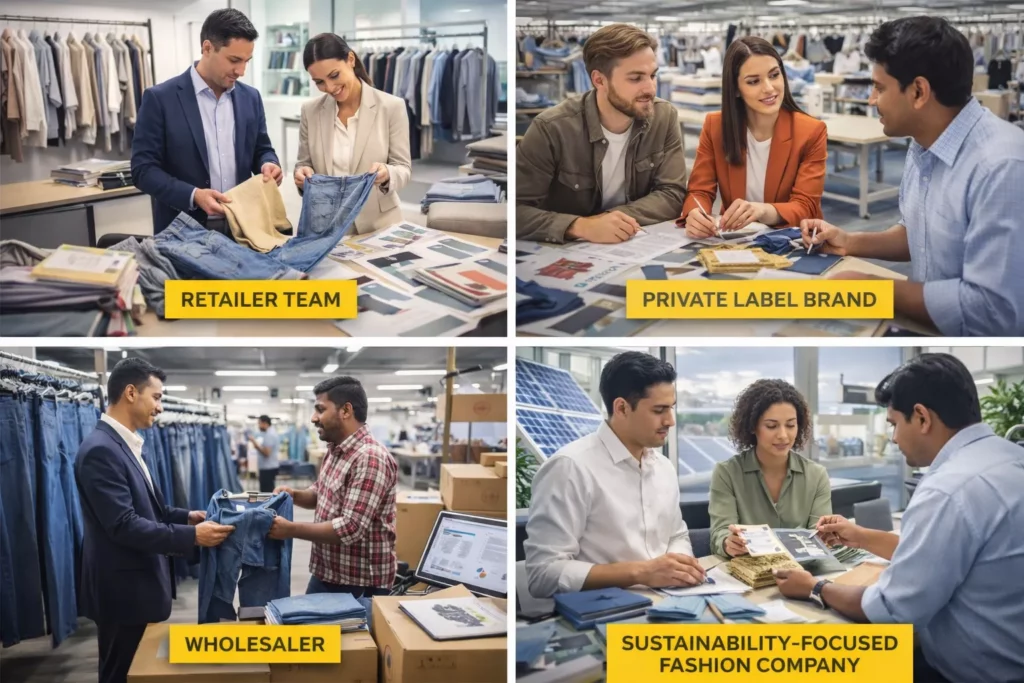
Bangladesh is not equally useful to every buyer, but it is highly attractive to several buyer types. Retail chains and wholesalers often benefit most because the country is built for repeatable volume. Large and mid-sized fashion brands also gain from supplier depth and established export routines. Private label businesses can benefit from Bangladesh’s category strength, especially in basics, uniforms, sweaters, denim, and casualwear. These observations are grounded in the sector’s scale, product mix, and export history.
Smaller foreign buyers can also work successfully in Bangladesh, but they usually need more selective supplier matching. Because much of the industry is optimized for larger runs, a small buyer may do better with a manufacturing partner, sourcing office, or supplier already comfortable with lower-volume development. Bangladesh can still be a strong option, but small buyers should not assume that every factory is interested in highly fragmented or experimental production. That conclusion follows from the market’s export structure and industrial orientation.
Buyers with strong sustainability goals should see Bangladesh as increasingly relevant, given the country’s green factory base and the investment attention going into green RMG. Buyers focused mainly on extremely technical or synthetic-heavy categories should take a more nuanced approach, since IFC has specifically identified the need for continued upgrading in man-made fibers and advanced production.
So the market fit question is not simply “Is Bangladesh good?” It is “Is Bangladesh good for this buyer, this category, and this production model?” In many cases the answer is yes, but the best results come when sourcing strategy matches industry reality.
Future Outlook for Foreign Buyers
Looking ahead, Bangladesh’s garment sector appears likely to remain highly relevant, but with a clear pressure to upgrade. IFC’s 2025 analysis points toward green RMG, technology adoption, and movement into man-made fibers as important future priorities. That suggests the country’s next phase will not be about abandoning its core strengths
in basics and bulk production, but about building on them.
For foreign buyers, this is encouraging. It means Bangladesh is not standing still while other sourcing markets evolve. It is trying to strengthen its position through sustainability, productivity, and product diversification. At the same time, the market will remain competitive, and buyers should expect continued pressure around price, trade policy, logistics resilience, and compliance expectations.
The most likely scenario is that Bangladesh continues to serve as one of the world’s leading apparel sourcing destinations, especially for buyers who need scale and category familiarity, while gradually broadening its capability base. Foreign buyers who understand both the strengths and the transition areas will be in a better position to build stable sourcing relationships there.
Partnering with the Right Bangladesh Manufacturing Network
Foreign buyers often achieve better sourcing outcomes when they work with experienced manufacturing partners who understand both local production systems and international buyer expectations. Navigating supplier selection, sampling approvals, fabric sourcing, quality control, and export coordination can be complex without the right guidance.
Companies such as ApparGlobal.com help international clothing brands connect with reliable Bangladesh garment manufacturers while supporting product development, sourcing decisions, production planning, and quality assurance. By aligning these processes early in the production cycle, brands can move from sampling to bulk manufacturing more efficiently and with fewer operational risks.
For many foreign buyers, partnering with knowledgeable sourcing teams can simplify the process of entering the Bangladesh apparel market while ensuring consistent production quality and reliable delivery.
Conclusion
For foreign buyers, the Bangladesh garment industry is best understood as a mature, large-scale, export-driven sourcing ecosystem with real depth in core apparel categories. The numbers support that view. Bangladesh exported about $38.48 billion in apparel in 2024, serves major markets such as the EU and US at scale, and remains deeply embedded in the global fashion supply chain.
Its biggest strengths are clear: proven manufacturing scale, a broad factory base, decades of export experience, category specialization in major product groups, and growing credibility in sustainability through its large base of green factories. At the same time, foreign buyers should approach the market with discipline. Supplier capability still varies, compliance must still be verified, and future competitiveness will depend partly on how well the sector upgrades in technology, fibers, and productivity.
The smart takeaway is not that Bangladesh is automatically the right answer for every apparel program. It is that Bangladesh is one of the world’s most important garment sourcing markets, and foreign buyers who understand how the industry really works can find strong long-term opportunities there. For many categories and many business models, it remains one of the most commercially relevant sourcing destinations in global apparel.
Frequently Asked Questions
Why is Bangladesh important for foreign apparel buyers?
Bangladesh is important because it is one of the world’s largest garment exporters, with about $38.48 billion in apparel exports in 2024, a large factory base, and strong export ties to the EU and US.
What products is Bangladesh strongest in?
BGMEA export data shows strong performance in trousers, T-shirts and knitted shirts, sweaters, shirts and blouses, and underwear, which reflects the country’s depth in core apparel categories.
How many garment factories are there in Bangladesh?
BGMEA says Bangladesh has 4,000+ factories serving major global fashion brands.
Is Bangladesh good for sustainable apparel sourcing?
It can be. BGMEA reported 258 LEED-certified green factories in August 2025, and IFC has identified Green Ready-Made Garments as a key investment opportunity in Bangladesh.
What should foreign buyers watch out for?
Buyers should watch for supplier differences in quality systems, communication, compliance maturity, and category fit. They should also monitor logistics and trade-policy developments that can affect timing and cost.