

How to Price Your Clothing Brand or Clothing Line
Price is one of the most important decisions in any clothing business. It shapes your profit margin, brand position, customer expectations, wholesale potential, marketing budget, and long-term survival. Yet many new apparel brands choose prices emotionally. Some copy competitors without understanding their own costs. Others set prices too low to attract buyers, then discover they cannot cover production, ads, shipping, returns, and business overhead. Some go too high without building enough product value to justify it.
The truth is simple. A beautiful product does not automatically become a profitable product. If your pricing is wrong, even a strong clothing line can struggle. That is why learning how to price your clothing line for profit is not just a finance task. It is a product strategy, branding, and growth strategy at the same time.
A profitable pricing model needs to connect five things clearly: your production cost, your operating cost, your target customer, your brand position, and your sales channel. A direct-to-consumer streetwear brand does not price the same way as a wholesale women’s label. A premium basics line does not price the same way as a trend-driven fast fashion brand. A hoodie with heavyweight fleece and custom trims cannot be priced like a standard promotional sweatshirt, even if the categories look similar on the surface.
In this guide, you will learn how to calculate clothing line prices step by step, how to understand garment cost and landed cost, how markup and margin differ, how wholesale changes the pricing model, how to protect profit when returns and discounts happen, and how to set prices that support real growth instead of short-term guesswork.
Pricing in the Global Apparel Industry
The global apparel market produces over 100 billion garments every year, making pricing strategy one of the most critical elements of fashion business success.
Industry reports show that fabric often accounts for more than half of a garment’s manufacturing cost, while labor, trims, and logistics make up the rest.
Because of these cost structures, clothing brands must carefully balance product quality, pricing strategy, and profit margins to remain competitive.
How to Price Your Clothing Line for Profit
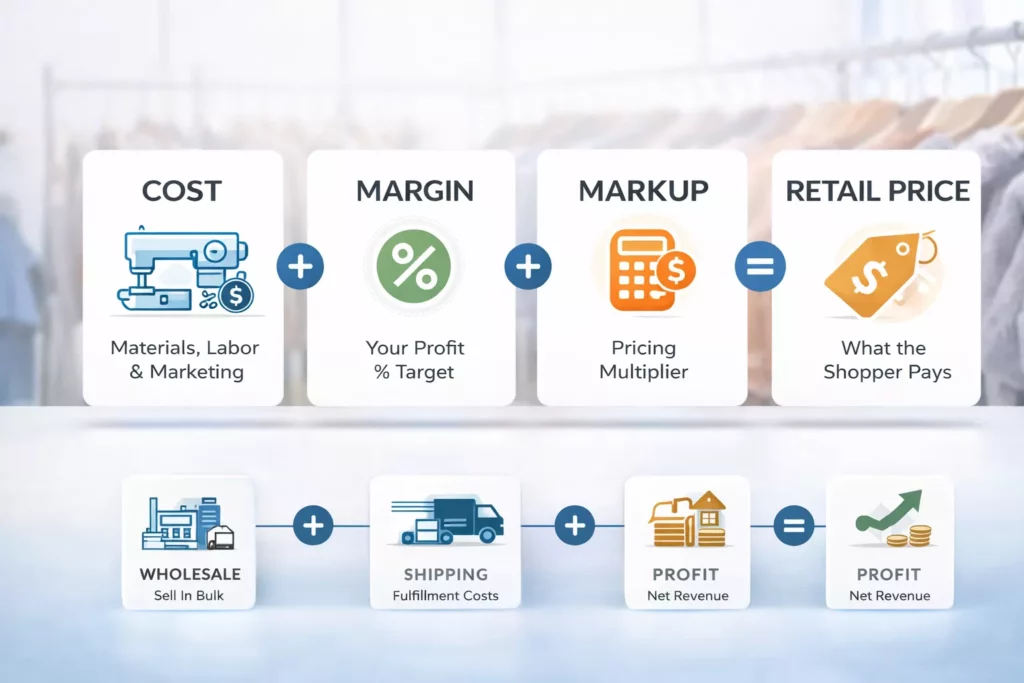
To price a clothing product profitably, brands usually follow these steps:
- Calculate the total product cost per item must be calculated accurately for effective pricing. (manufacturing, packaging, shipping, duties)
- Add operating costs such as payment fees, returns, and marketing
- Decide a target gross margin
- Use a pricing formula to determine the retail price
- Compare the final price with market competitors and brand positioning
A profitable clothing price ensures the product covers costs while still leaving room for marketing, discounts, and business growth.
Why Pricing Matters More Than Most Fashion Founders Expect
Many new clothing brands treat pricing as the final step. In reality, pricing should influence product decisions much earlier. Before approving a fabric, a trim package, or a production method, you should already be asking whether the final product can support a profitable selling price.
Pricing affects:
- profit per unit
- cash flow
- customer perception
- inventory risk
- discount flexibility
- wholesale viability
- marketing budget
- long-term scalability
If your clothing line is underpriced, every sale may create pressure instead of progress. You may generate revenue but still struggle to pay for ads, photography, packaging, shipping supplies, samples, and reorders. If your line is overpriced without enough product value, conversion slows and customers lose trust. That is why strong pricing is about balance, not extremes.
A good pricing system helps you answer practical questions like these:
- Can this product survive a discount and still make money?
- Can this product work in both DTC and wholesale?
- Can I afford customer acquisition at this price point?
- Can I reinvest into better content, better inventory, and better production?
When pricing is handled properly, it gives your brand room to grow. When it is weak, it quietly damages everything else.

How to Choose a Profitable Fashion Pricing Strategy
When starting a clothing line, market research helps you figure out how much to set your price so you can price clothing to match demand and expect to sell. Calculate cost per unit, cost per style, and the cost of goods sold (cog), including screen printing, hang tags, and wholesale cost to know the true unit cost before adding markups for a desired profit margin.
Include indirect costs, overhead costs, and other business expenses so your price tag covers business costs and marketing costs. Choose among pricing methods — price to sell, price higher for high-end or high prices, or a lower price to sell at wholesale or directly to consumers.
If you pre-order or sell at wholesale, factor wholesale and retail differences and how much it costs to produce so you can price your products competitively, cover higher costs, and build a sustainable business with higher profit across your product line. Decide what you might sell and when to start selling.
What Are The 4 Methods Of Pricing?
There are four common pricing methods: cost-plus, value-based, competitor-based, and dynamic pricing. Cost-plus focuses on the costs involved and adds a markup to secure a good profit, making it simple for manufacturers managing a minimum order. Value-based pricing charges customers based on perceived benefits, which supports premium positioning and long-term success.
Competitor-based pricing watches rivals and matches or undercuts them, useful when you choose to outsource production or benchmark against market leaders. Dynamic pricing adapts to demand, seasonality, and inventory and is often featured in a practical 2024 guide for modern sellers balancing revenue and customer satisfaction.
Choosing the right method depends on product lifecycle, customer sensitivity, and business goals; mixing approaches—like cost-plus for baseline and value-based for flagship items—helps ensure profitability and sustainable growth.
Start With the Difference Between Markup and Margin
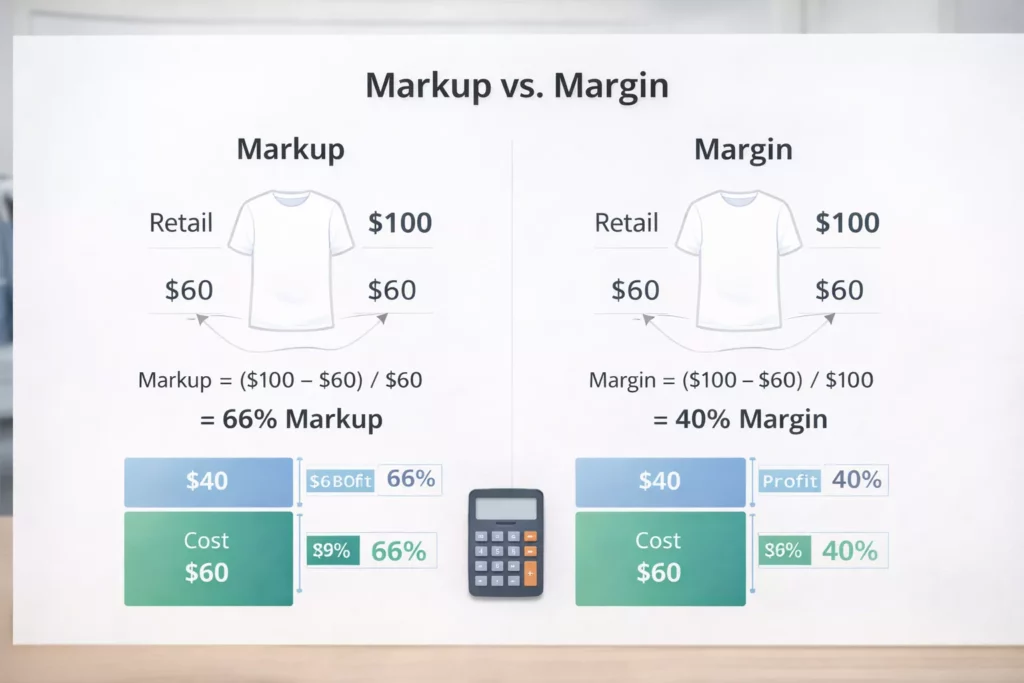
One of the most common pricing mistakes in apparel is confusing markup with profit margin. These are not the same thing, and if you mix them up, you can think a product is profitable when it is actually weak.
What Is Markup?
Markup is the amount you add on top of your cost to reach a selling price.
Formula:
Selling Price = Cost + Markup
If a garment costs $20 and you sell it for $40, your markup is $20, or 100% of cost.
What Is Profit Margin?
Profit margin is the percentage of the selling price that remains after cost is removed, including all marketing costs.
Formula:
Profit Margin = (Selling Price – Cost) ÷ Selling Price
If a garment costs $20 and sells for $40, the gross margin is 50%.
This matters because a 100% markup sounds large, but it does not mean huge profit once you factor in ads, shipping support, returns, payment fees, packaging, and overhead. Many founders think doubling the cost is enough. In some cases it is not even close, especially if the brand wants room for discounts or wholesale later.
Understanding margin early helps you price more realistically and avoid the trap of “good sales but weak profit.”
Know Your True Cost Before Setting Any Price
You cannot price for profit if you do not know your actual cost. Many brands only look at factory cost and ignore everything else. That leads to underpricing very quickly.
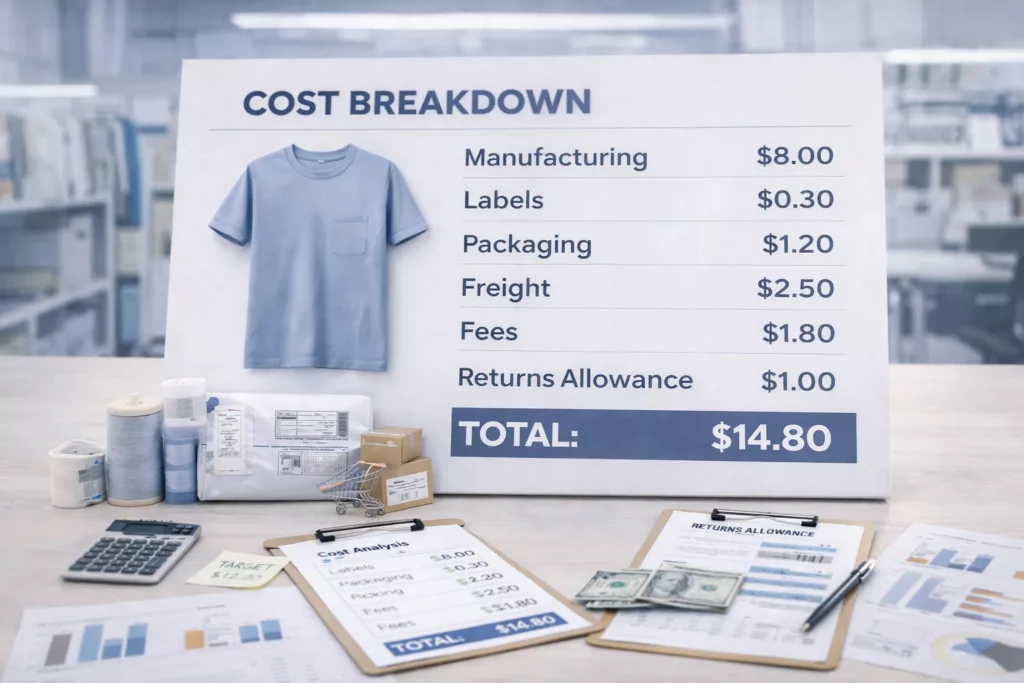
Your true cost should usually include:
- manufacturing cost
- fabric and trims if priced separately
- labels and packaging
- freight from factory
- duties or import costs if applicable
- sampling cost allocation
- quality control or inspection cost
- payment processing and transfer fees
- storage or handling cost
- shipping materials
- returns allowance
- product photography allocation if relevant
This is why a hoodie that costs $18 at the factory may not really be an $18 product. Once freight, packaging, and operating realities are included, the actual landed and operational cost may be much higher.
A smart founder prices based on fully loaded product cost, not only FOB or ex-factory cost. When you know the real number, you can make better decisions about fabric upgrades, packaging choices, and whether a product is even commercially viable at your target price point.
Understand Landed Cost, Not Just Production Cost
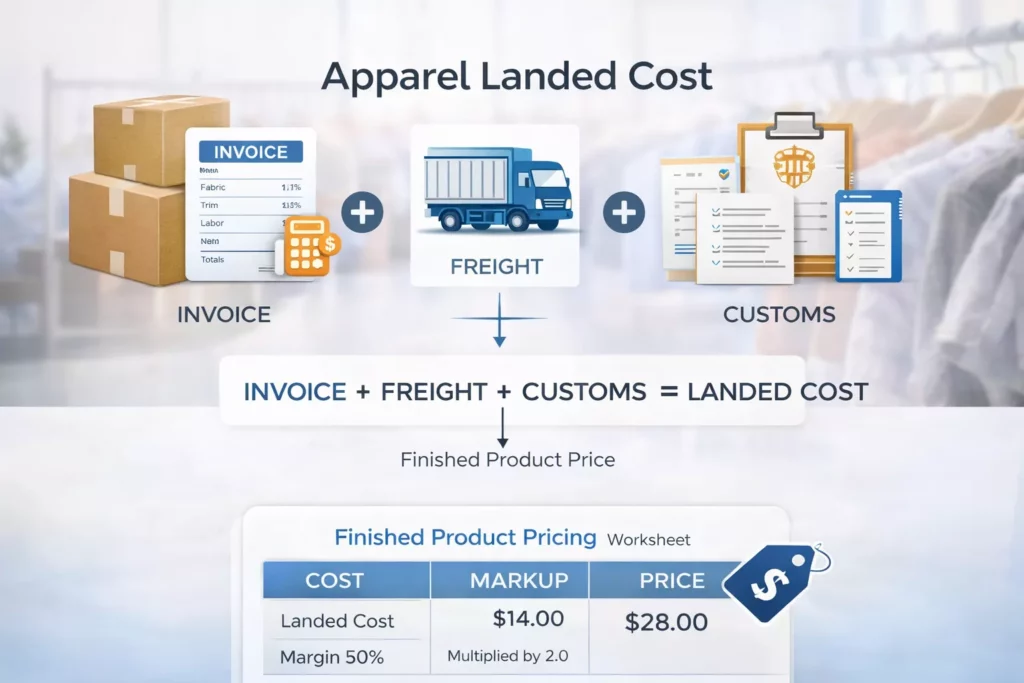
A lot of pricing problems come from ignoring landed cost. Production cost tells you what the garment costs to make. Landed cost tells you what it costs to get that garment ready for your business to sell.
Landed cost may include:
- factory price
- freight and shipping
- duties and taxes if applicable
- customs or clearance charges
- labeling and packaging cost
- handling and storage
- delivery to warehouse or fulfillment center
If you import from overseas, this step becomes especially important. A product may look profitable when you only compare factory quote to retail price, then become much tighter once shipping and import costs are added.
For example, a t-shirt quoted at $6 may look great on paper. But after freight, duty, packaging, and quality control, it may effectively become an $8 or $9 product before you even spend anything on marketing. That changes the retail price you need in order to protect margin.
If you want stable profitability, always calculate price from landed cost, not from the factory quote alone.
The Basic Clothing Pricing Formula
Once your real cost is clear, you need a practical formula for setting price. While every brand can refine its own system, a simple structure helps:
Step 1: Calculate Total Product Cost
This includes fully loaded landed cost plus reasonable product-related operating allocation.
Step 2: Decide Your Target Gross Margin
This depends on your brand model, whether you sell DTC, wholesale, or both, and how much room you need for marketing and discounts.
Step 3: Set Retail Price Based on Margin Goal
Use your margin target to determine the minimum viable retail price.
Formula:
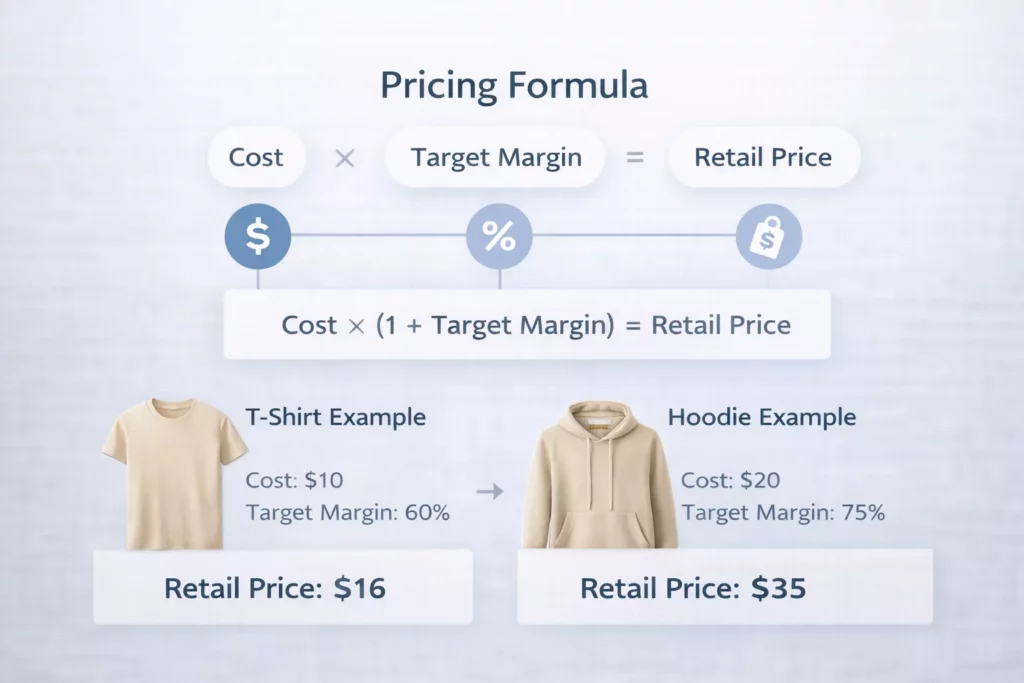
Retail Price = Total Cost ÷ (1 – Target Margin)
Example:
If your true product cost is $18 and you want a 65% gross margin, you need to carefully price your products.
Retail Price = 18 ÷ (1 – 0.65)
Retail Price = 18 ÷ 0.35
Retail Price = $51.43
In real apparel retail, you might round that to $52, $54, or $55 depending on brand position and pricing psychology.
This formula is simple, but it is one of the best ways to stop guessing. It makes the relationship between cost and margin clear, helping in building pricing strategies.
Typical Cost Components in Apparel Production
| Cost Component | Typical Share of Garment Cost |
| Fabric | 50–70% |
| Trims and accessories | 5–10% |
| Labor (cutting, sewing, finishing) | 15–25% |
| Packaging and logistics | 5–10% |
| Factory overhead and margin | 5–10% |
How Gross Margin Supports Real Profit
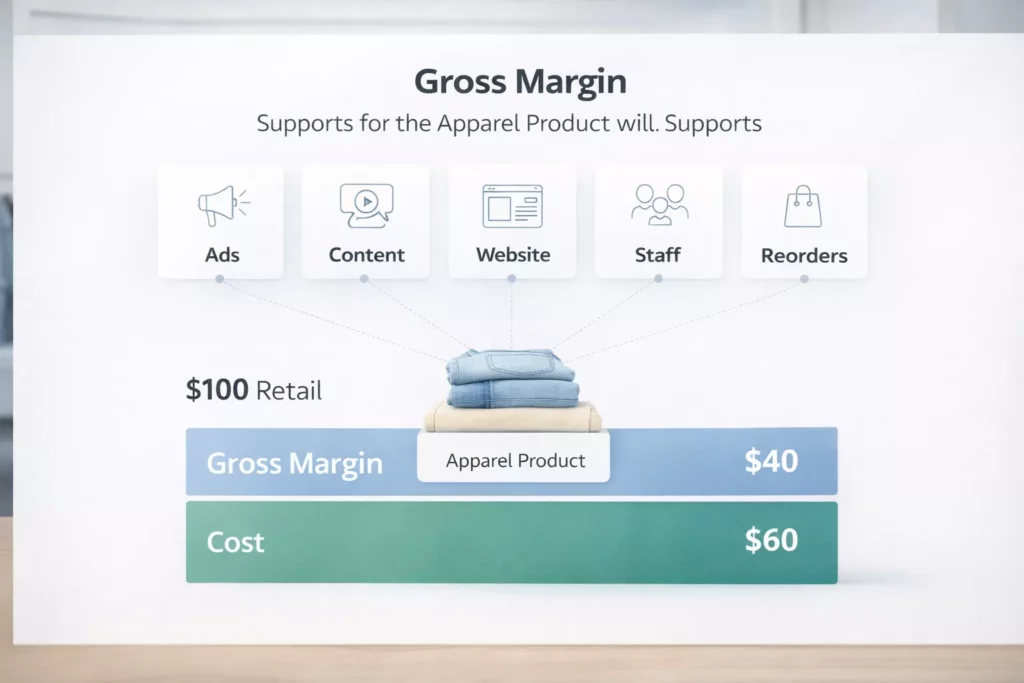
Gross margin is not your final profit, but it is one of the strongest indicators of whether your product can support your business. A healthy gross margin gives you room for marketing, returns, discounts, and operating expenses.
In a clothing brand, gross margin helps fund:
- ad spend
- email and SMS tools
- creative production
- staff or contractors
- website fees
- fulfillment mistakes
- customer support
- seasonal markdowns
- future inventory buys
A product with a weak gross margin can still generate sales, but it often creates long-term pressure. You may feel busy but remain underfunded. On the other hand, a stronger margin gives you options. It lets you test ads, survive occasional promotions, and keep reinvesting into the brand.
This is why profitable pricing is not only about immediate unit gain. It is about building enough cushion that the brand can keep moving.
Typical Pricing Logic for Direct-to-Consumer Clothing Brands
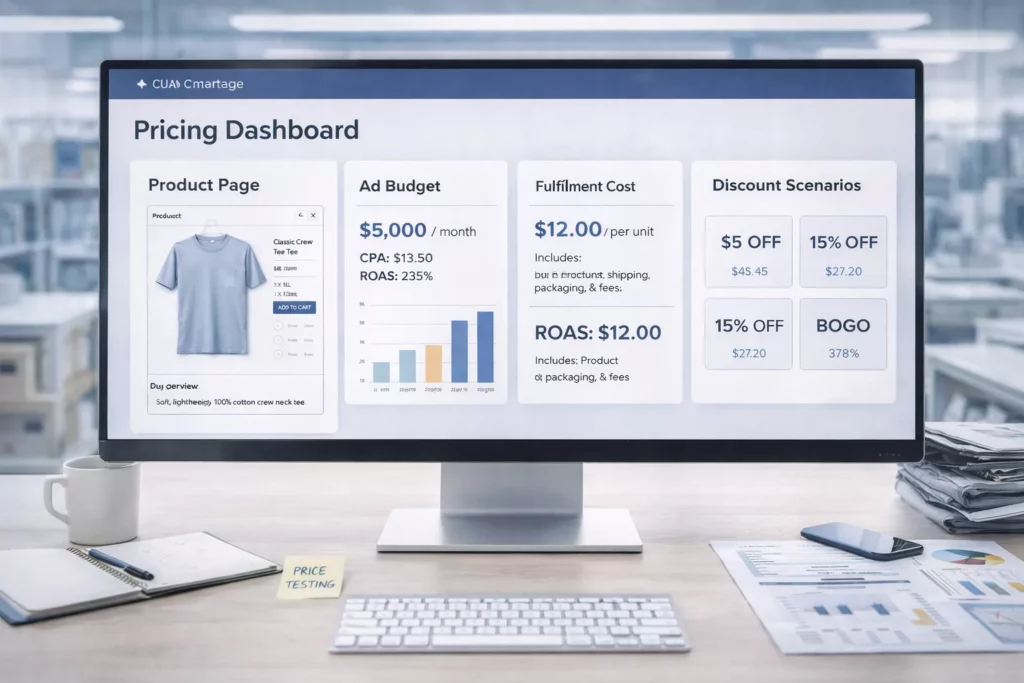
Direct-to-consumer brands often have more pricing control because they sell through their own website or owned channels. But they also carry more responsibility for marketing, customer acquisition, fulfillment, and returns.
For DTC brands, the retail price often needs to support:
- product cost
- acquisition cost
- fulfillment cost
- returns and exchanges
- brand-building overhead
- future growth
This means a DTC price should not be based only on what “feels affordable.” It should be based on whether the product can attract and keep customers while still leaving enough room for sustainable contribution margin.
DTC brands also need to think about discount pressure. If your regular price is already too low, running common promotions like 10% off, 15% off, or launch bundles can destroy profitability very fast.
A strong DTC pricing strategy gives the brand space to market effectively without constantly depending on panic discounting.
Wholesale Changes the Pricing Strategy Completely
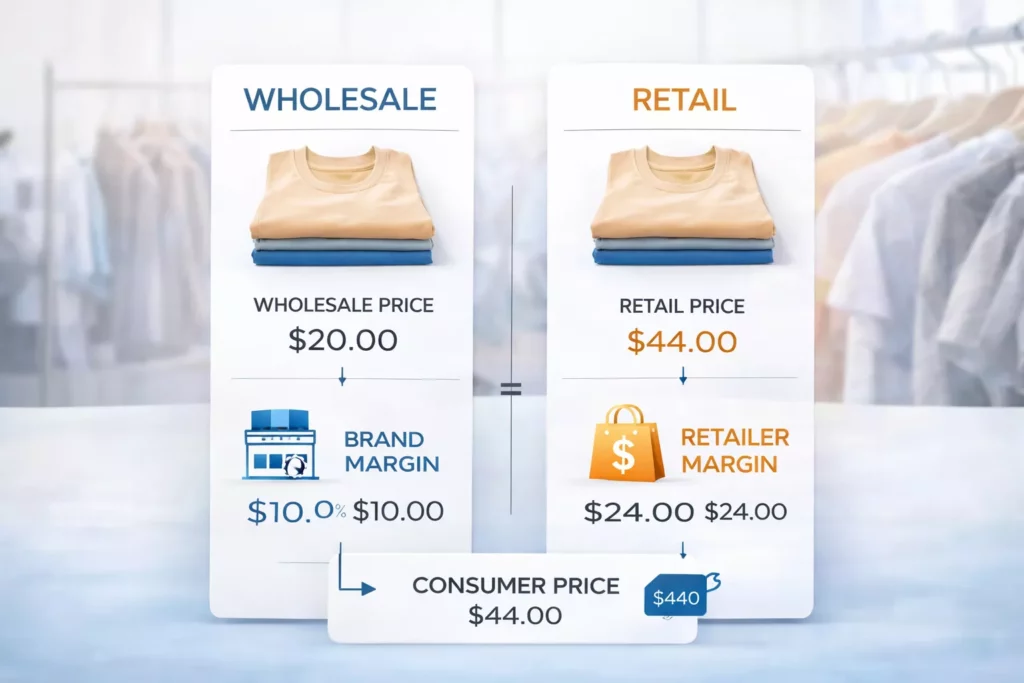
If your clothing line plans to sell wholesale to boutiques, retailers, or distributors, you cannot price like a pure DTC brand. Wholesale buyers need enough margin for themselves, which means your retail price must support both your wholesale price and the retailer’s business.
A common logic in apparel is that wholesale price is often significantly below retail price so that retailers can mark the product up and still operate profitably. That means founders who want wholesale later must think ahead.
For example, if your product costs $18 landed and you sell DTC only, a $55 price might look workable. But if a retailer wants to buy the same product at a much lower wholesale rate, your margin may collapse unless the retail price is higher or your product cost is lower.
This is why many brands ask an early strategic question:
Do I want this product to work for DTC only, or do I want future wholesale flexibility too?
The answer changes pricing significantly. If wholesale matters, build that into the model from the beginning.
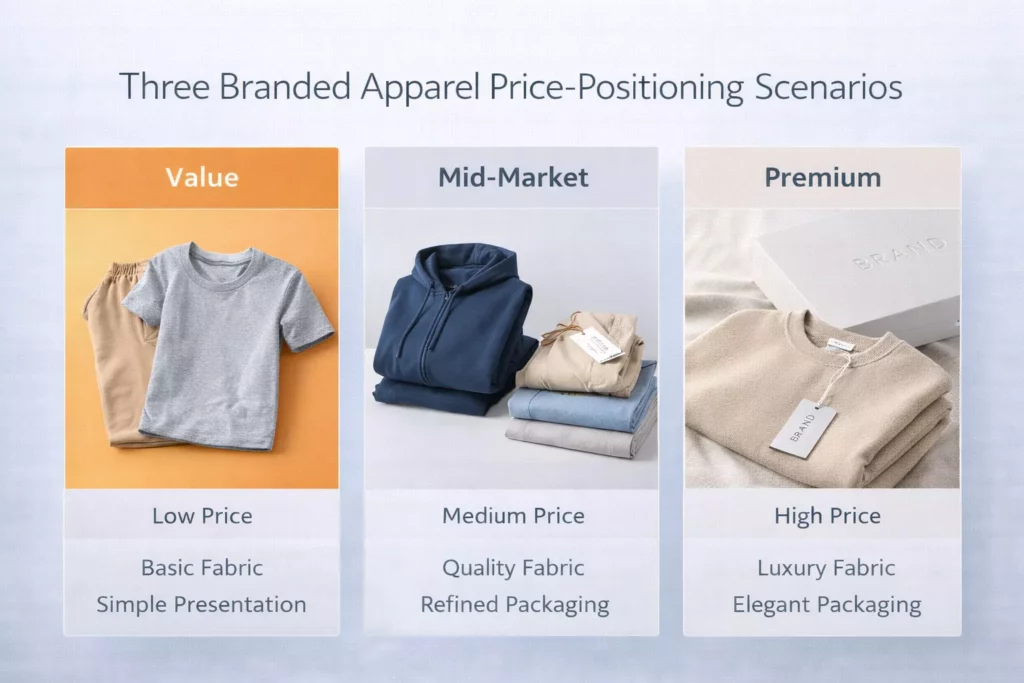
Price Based on Brand Position, Not Only on Cost
Cost matters, but price should not be determined by cost alone. It should also reflect your brand’s position in the market.
A basic t-shirt can sell at very different prices depending on:
- fabric quality
- fit and silhouette
- branding
- packaging
- content and photography
- community and demand
- brand story and perception
That means pricing is partly financial and partly strategic. A premium basics brand may charge more because the fabric, fit, and brand language support a stronger perceived value. A budget casualwear brand may need tighter pricing because its value proposition is accessibility. A niche activewear label may command more if performance and design feel differentiated.
The key is alignment. If your brand looks premium, your fabric feels premium, and your customer experience supports that promise, a higher price can make sense. But if your price is premium while the product and presentation feel weak, conversion and trust suffer.
Your price should make sense within the full product experience.
Competitor Pricing Is Useful, but Do Not Copy It Blindly
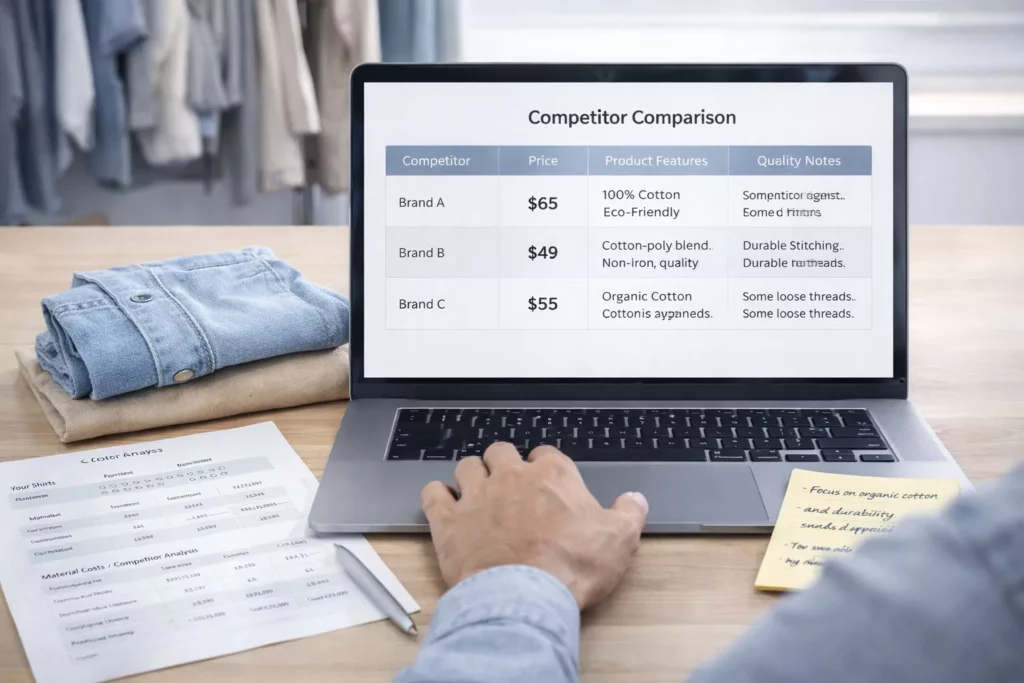
Looking at competitors is smart. Copying their prices without context is not.
Competitor pricing can help you understand:
- the acceptable market range
- customer expectations in your category
- how premium or affordable your offer looks
- how crowded the segment is can influence how you set your price and market your products.
But competitors may have:
- different cost structures
- larger production runs
- stronger brand loyalty
- lower acquisition costs
- better supplier terms
- different quality levels can significantly affect how you price your clothing brand.
- more room for discounts
So competitor pricing should guide your positioning, not dictate it. If your hoodie costs more to make than a competitor’s because you use better fleece and lower MOQs, your price may need to be higher. If your t-shirt quality is weaker than established premium players, pricing above them may be unrealistic.
The best use of competitor pricing is comparison, not imitation. Understand where you fit, then price from your own business logic.
Build Enough Room for Discounts and Promotions
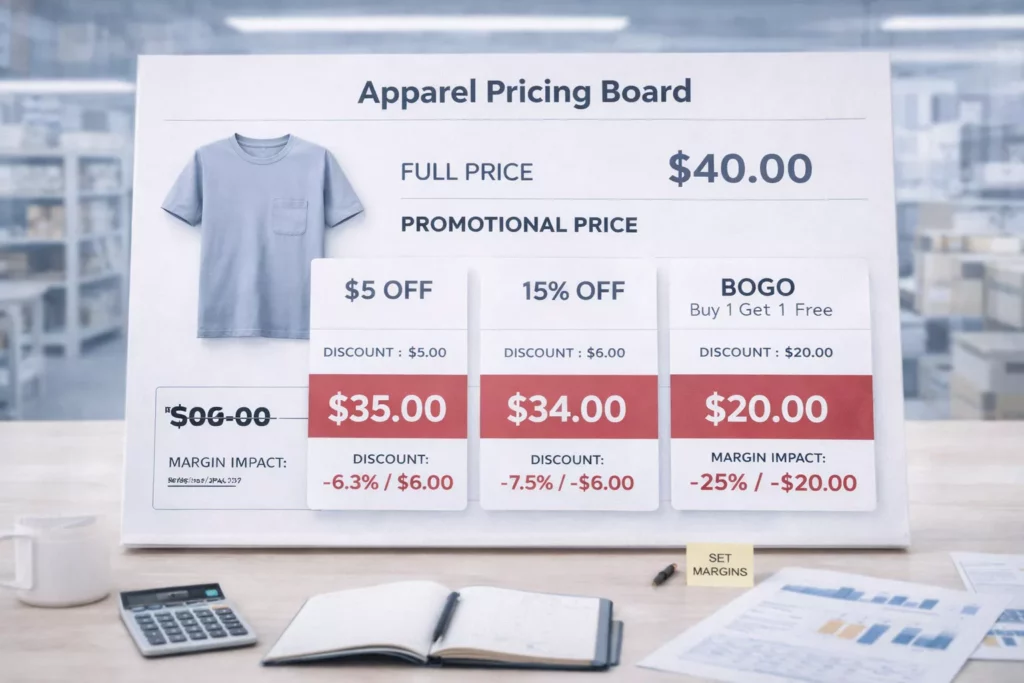
Very few clothing brands sell every unit at full price forever. Promotions happen. Bundles happen. Seasonal markdowns happen. VIP discounts happen. That is why pricing should include room for flexibility.
If your pricing is too tight, even a small discount can hurt badly, leading to higher costs in the long run. A 10% to 20% reduction may not look dramatic from the customer side, but it can remove a large share of your profit if the original price was already weak.
A healthier pricing model allows room for:
- launch offers
- email signup discounts
- bundles
- seasonal promotions
- end-of-season markdowns
- wholesale negotiations
- occasional return-related recovery costs can impact your overall marketing costs.
This does not mean inflating price artificially just to discount later. It means understanding that fashion retail usually includes price movement, and your margin needs to survive that reality.
Strong brands price with flexibility in mind instead of reacting in panic once discounting becomes necessary.
Returns, Exchanges, and Shipping Support Must Be Counted
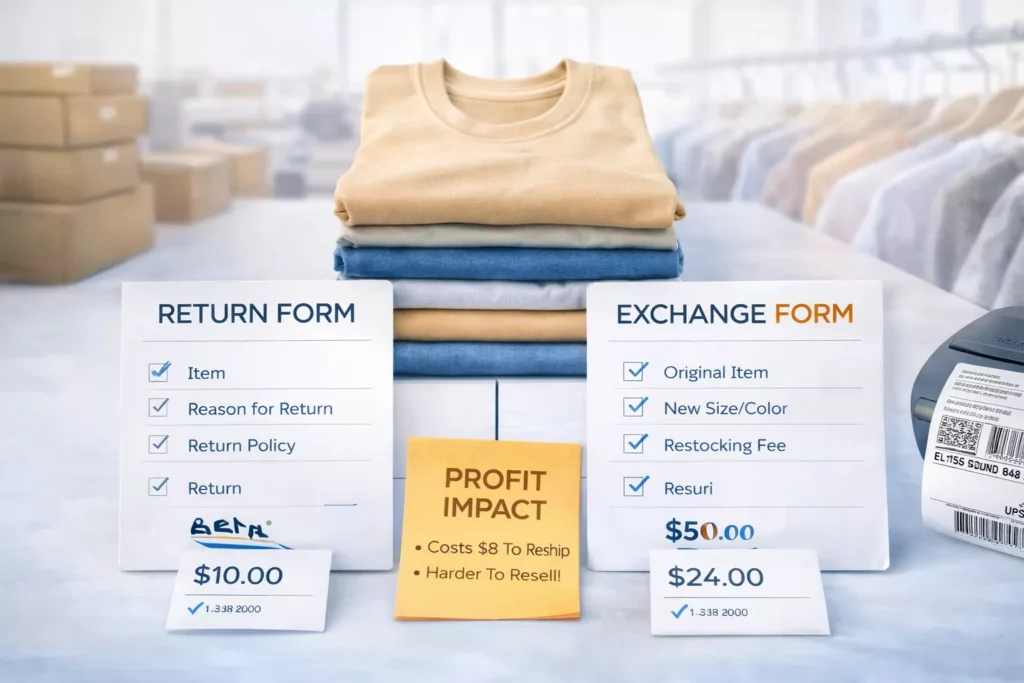
Many founders forget to price for the cost of being a real ecommerce business. Returns, exchanges, lost parcels, damaged items, and customer service adjustments all affect profit.
Depending on your model, your business may absorb:
- return shipping support
- exchange handling
- replacement units
- packaging loss
- payment fee loss on refunded orders
- additional customer service time
That does not mean every product needs a huge returns buffer, but it does mean your price should reflect operational reality. A clothing line that ignores returns in pricing often discovers the problem later through shrinking margins rather than obvious cost spikes.
This is especially important in categories with fit sensitivity such as dresses, denim, trousers, and activewear. If the return behavior in your category is likely to be higher, your margin model needs to be stronger.
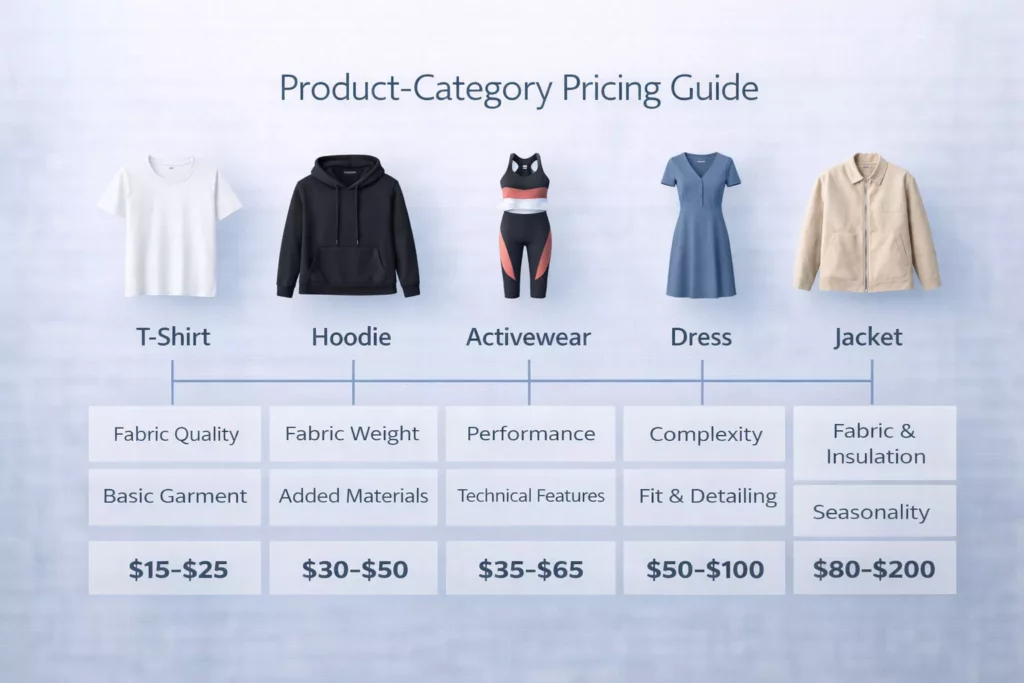
How to Price Different Product Categories
Not every garment should follow the same pricing logic. Product category affects perceived value, replacement frequency, customer comparison behavior, and tolerance for premium positioning.
T-Shirts and Basics
Customers compare basics heavily, so fabric, fit, and brand differentiation matter. A basic tee needs either strong value or strong premium justification.
Hoodies and Sweatshirts
These often support higher price points because customers expect more material, warmth, and visible quality. Heavyweight fleece and fit can justify stronger margins.
Activewear
Performance, support, stretch, opacity, and lifestyle branding all affect pricing. Customers often pay more when the product clearly solves a function.
Dresses and Fashion Pieces
These may support emotional pricing, but returns and fit issues can also be higher. Margin planning needs to account for that.
Outerwear
These pieces often allow larger price moves because they feel more substantial, but cost is also higher and demand can be seasonal.
Different categories create different pricing psychology. That is why your clothing line should price by product logic, not by one universal formula for every item.
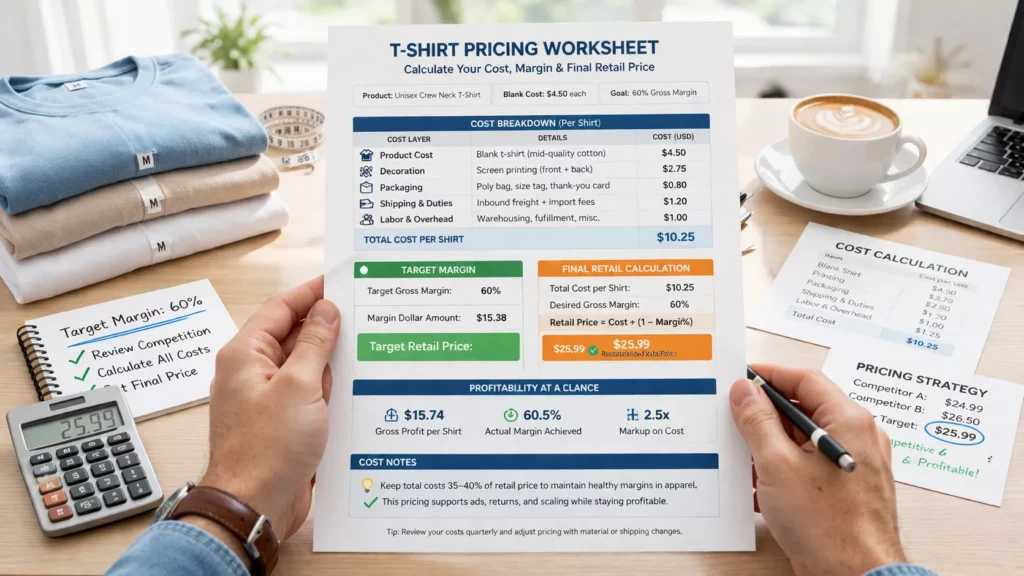
Example Pricing Breakdown for a T-Shirt
Let’s look at a simplified example.
Imagine a premium basic t-shirt with these approximate costs:
- factory cost: $7.00
- label and packaging: $0.80
- freight and duties allocation: $1.20
- QC and handling allocation: $0.50
- total landed cost: $9.50
Now add an operations buffer for returns, payment fees, and product-level support, bringing effective cost closer to $11.00.
If the brand wants a 65% gross margin:
Retail Price = 11 ÷ (1 – 0.65)
Retail Price = 11 ÷ 0.35
Retail Price = $31.43
Now the founder must decide whether that price fits the brand. If the market and brand position can support $32 to $36, the product may work. If not, something must change: cost, margin target, or product concept.
This example shows why pricing is not just about “what feels fair.” It is about whether the whole product system works.
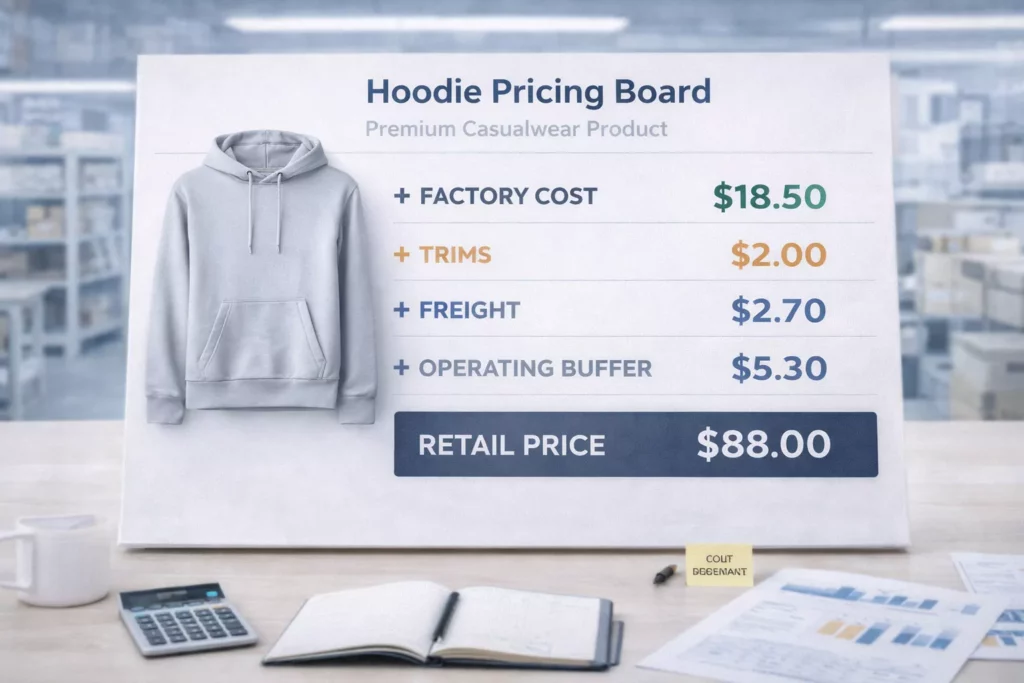
Example Pricing Breakdown for a Hoodie
Now consider a heavier category.
Approximate costs:
- factory cost: $18.00
- trims and packaging: $1.50
- freight and duties allocation: $2.00
- QC and handling allocation: $0.75
- total landed cost: $22.25
Add operating buffer and returns support, and the effective cost may become $24.00 to $25.00.
If the target gross margin is 65%:
Retail Price = 25 ÷ (1 – 0.65)
Retail Price = 25 ÷ 0.35
Retail Price = $71.43
Now the brand must decide whether a $72 to $78 hoodie is credible in its market. If the product uses strong fleece, good fit, quality branding, and premium presentation, it may be. If not, pricing that high may be difficult.
This is why product quality and price position must move together. The hoodie’s fabric and execution need to justify the business math.
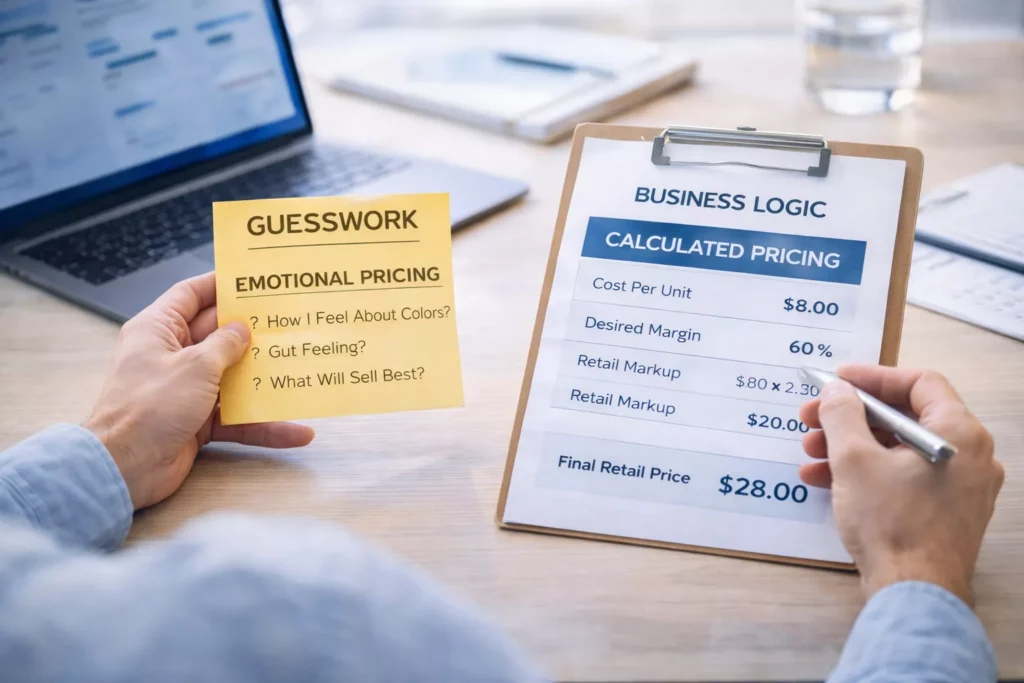
Do Not Set Prices Emotionally
A lot of founders underprice because they ask the wrong question. They ask, “What would I personally want to pay?” instead of “What does this product need to cost to support a healthy business and fit the market?”
Pricing emotionally leads to mistakes like:
- setting price based on fear
- underpricing to get first sales
- pricing based on compliments instead of cost
- pricing based on personal affordability rather than target market
- using round numbers without margin logic
A clothing line is not healthier because it looks affordable. It is healthier when the price matches the business model. That includes making enough on each sale to support future inventory, marketing, and better operations.
The customer is not only buying the fabric and stitching. They are buying the brand, fit, packaging, website experience, photography, and service. Your price should reflect the full offer.
Your Pricing Should Support Reorders and Growth
A profitable brand is not just one that sells. It is one that can reorder inventory, improve products, and survive mistakes. This is why pricing should be tested against future needs, not only current launch excitement.
Ask yourself:
- Can this product fund a reorder deposit?
- Can it support ad testing after launch?
- Can it handle returns and still contribute profit?
- Can it support stronger content next season?
- Can I improve packaging or fabric later without breaking the model?
If the answer is no, your price may be too low or your product cost too high. Healthy pricing helps you move from launch to repeatability. Weak pricing keeps you stuck in reactive mode.
A clothing line becomes much more stable when its products create enough profit to fund the next step instead of depending on new outside cash every time.
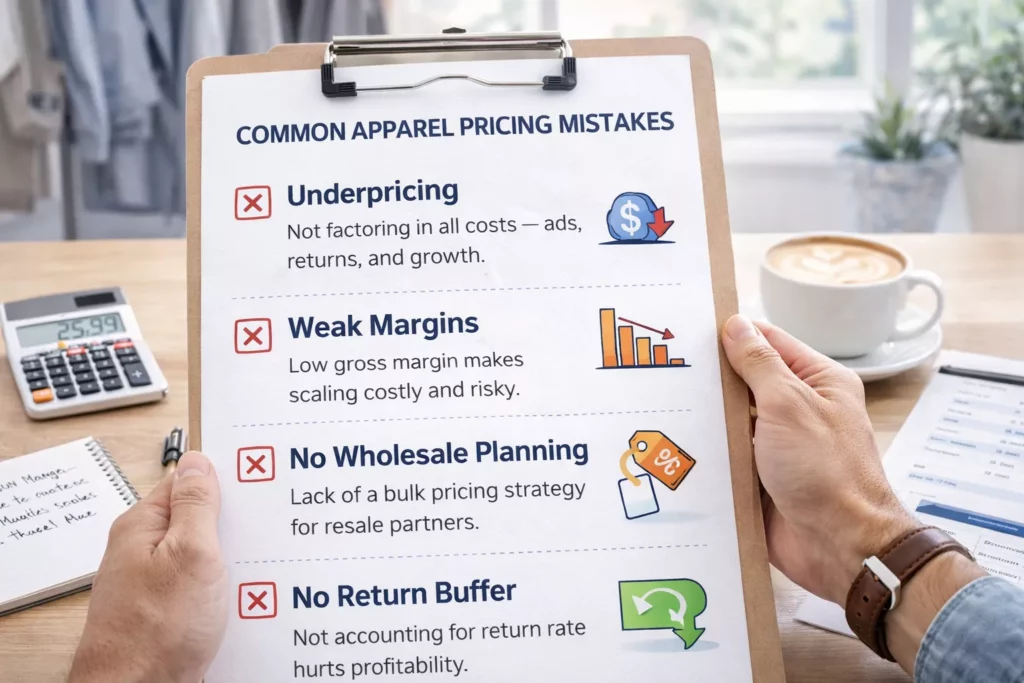
Common Pricing Mistakes Clothing Brands Make
Even strong-looking brands often make the same pricing errors.
Ignoring Fully Loaded Cost
They price from factory quote only and miss landed and operational reality.
Confusing Margin With Markup
They think doubling cost is always enough.
Underpricing to “Get Sales”
They attract buyers but damage long-term profitability.
Pricing Too High Without Value Support
They aim for premium pricing without premium product experience.
Not Planning for Wholesale
They later discover the product cannot work in both channels.
Forgetting Discounts and Returns
They assume every sale happens at full price and with no friction.
Using the Same Logic for Every Product
They price a t-shirt, hoodie, and dress with no category difference.
Avoiding these mistakes can improve your clothing line’s financial stability dramatically.
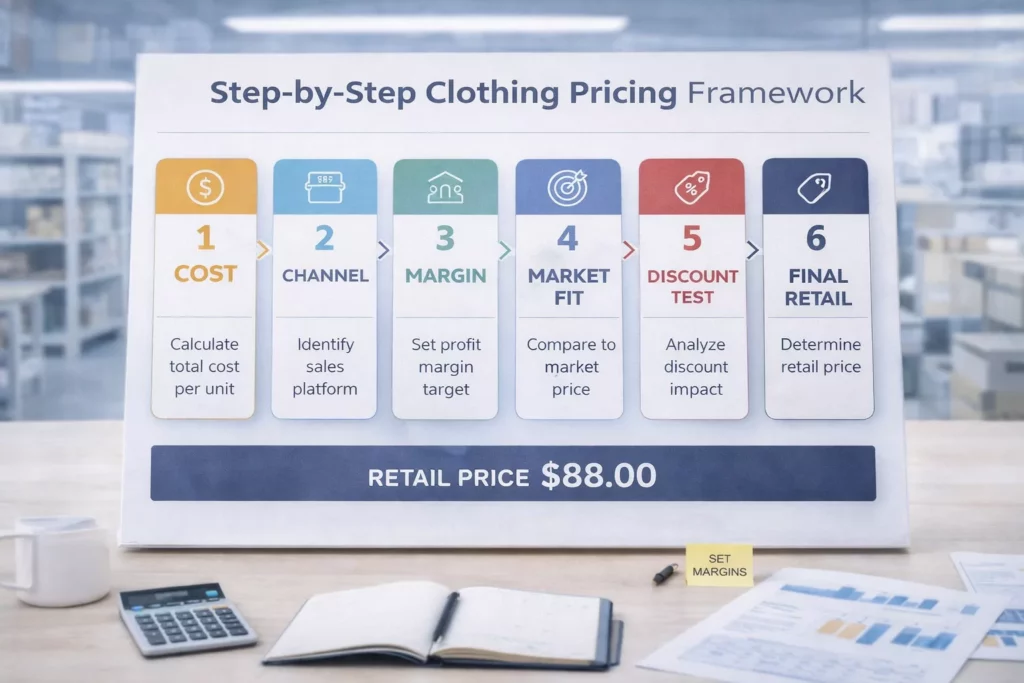
A Simple Step-by-Step Pricing Process for Beginners
If you are building your first clothing line, use this practical process:
Calculate Full Product Cost
Include factory, packaging, freight, duties, and product-level operating allocation.
Decide Your Channel Strategy
Are you DTC only, or do you need wholesale flexibility later?
Set a Margin Goal
Choose a realistic target based on your brand model and growth needs.
Review Market Position
Check where your product fits compared with competitors and category expectations.
Test the Retail Price
Ask whether the final price aligns with brand perception, customer logic, and unit economics.
Stress-Test Discount Scenarios
See what happens if the product sells at 10% or 20% off.
Finalize and Stay Consistent
Do not keep changing prices without strategic reason.
This process gives beginners a real framework instead of relying on random pricing instincts.
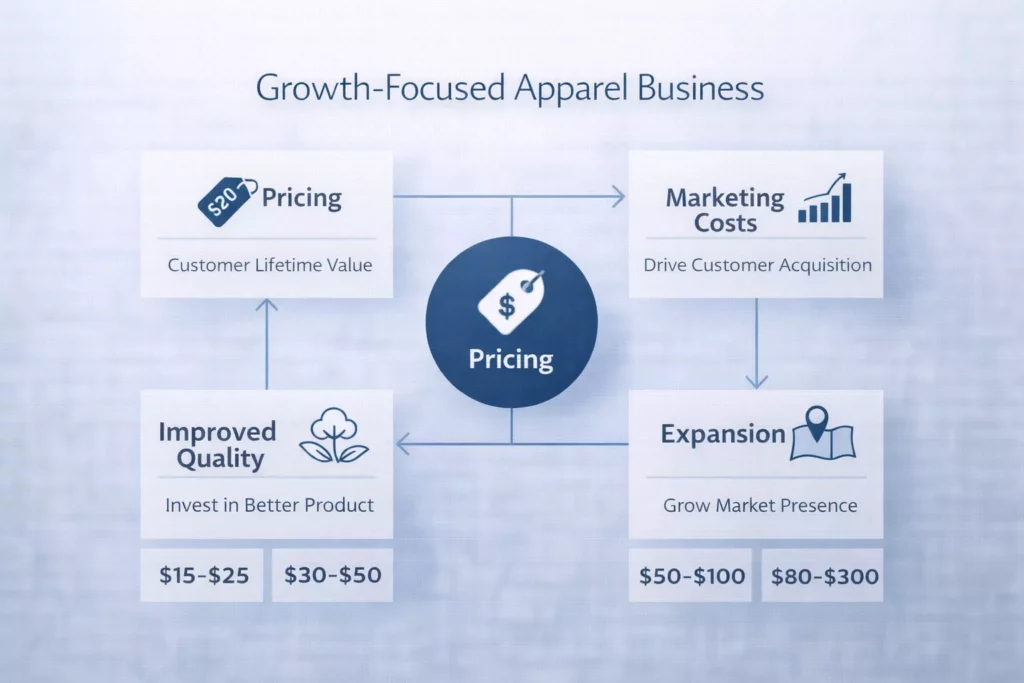
Setting Your Price: Markups, Margins, and Models
When you price your clothing brand while starting a clothing line, the first step is to calculate the cost per unit or unit cost — that is much it costs to produce each item, including screen printing and the cost of goods sold (cog). Add indirect costs and overhead costs like rent and business expenses to get a realistic build pricing baseline for your product line.
From there choose pricing methods and set a desired profit margin so you know whether to price to sell with a lower price or price higher for premium positioning. Decide if you’ll sell at wholesale or directly to consumers, compare wholesale cost vs retail, and estimate how many units you expect to sell. Use market research and options like pre-order to reduce risk and ensure a sustainable business rather than setting high prices that few might sell or a price tag that undercuts margins when covering business costs and COGS.
How to Know If Your Price Is Too Low or Too High
There are usually signals.
Your price may be too low if you want to set your price effectively:
- profit disappears after ads or discounts
- customers do not question the price at all despite premium claims
- reorders feel financially stressful even when sales are good
- wholesale becomes impossible
- cash flow stays tight despite decent revenue
Your price may be too high if:
- conversion is very weak despite strong traffic
- customers compare you unfavorably with better-known brands
- the product experience does not feel aligned with the price
- you rely on constant discounting to move stock
Sometimes the problem is not the price alone. It may be the offer. Better fabric, better photos, stronger fit messaging, and more trust signals can improve pricing power. But the first step is always honest evaluation.
Image Prompt:
Pricing diagnostics board showing warning signs for prices being too low or too high, with ecommerce metrics and apparel samples, 16:9.
ApparGlobal
Many clothing brands build stronger pricing systems when they work with apparel partners that understand fabric cost, product development, sourcing strategy, MOQ planning, and manufacturing efficiency. Companies such as ApparGlobal help clothing brands align garment specifications, production workflows, quality expectations, and cost structure so product pricing becomes more realistic, more scalable, and more profit-focused from the beginning.

Clothing Line Pricing Checklist
Before finalizing product pricing, clothing brands should confirm:
- Total product cost including shipping and packaging
- Target gross margin is realistic
- Price fits the brand’s market position
- Competitor pricing has been reviewed
- Profit remains after marketing and operational costs
Using a structured pricing checklist helps prevent underpricing and profit loss.
Conclusion
Learning how to price your clothing line for profit is one of the most important skills in building a sustainable apparel brand. Profitable pricing starts with knowing your true cost, understanding landed cost, choosing the right margin target, and making sure your retail price supports your brand position, sales channel, and long-term growth.
The strongest clothing brands do not price by fear, guesswork, or imitation. They price through clarity. They understand what their garments cost to make, what their customers expect, how much room they need for discounts and returns, and how profit supports the next stage of growth. That is what turns pricing into strategy instead of stress.
If you build your pricing that way, your products do more than generate sales. They help fund marketing, reorders, stronger content, better customer experience, and a healthier clothing business over time