

Understanding Fabric Shrinkage: Standards and How to maintain Fabric
Fabric shrinkage is one of the most important quality risks in apparel manufacturing. A garment can look perfect during development, pass sample approval, and still fail in the market if the fabric shrinks too much after washing, steaming, or consumer use. When that happens, the problem is bigger than product appearance. Shrinkage can damage fit consistency, increase return rates, create buyer complaints, and weaken brand trust.
In modern apparel production, shrinkage affects almost every category in some way, including t-shirts, hoodies, denim, woven shirts, dresses, activewear, knitwear, and children’s clothing. Some fabrics shrink because of fiber behavior. Others shrink because of finishing problems, weak process control, or poor communication between mill, factory, and brand. In many cases, shrinkage is not a surprise defect. It is a preventable production issue that was not managed early enough.
This guide explains fabric shrinkage and how to prevent it in production in a clear beginner-friendly way. You will learn what shrinkage means, why it happens, which fabrics are more vulnerable, how shrinkage is tested, what acceptable tolerances usually look like, and what apparel brands and manufacturers can do to reduce shrinkage risk before bulk production begins.
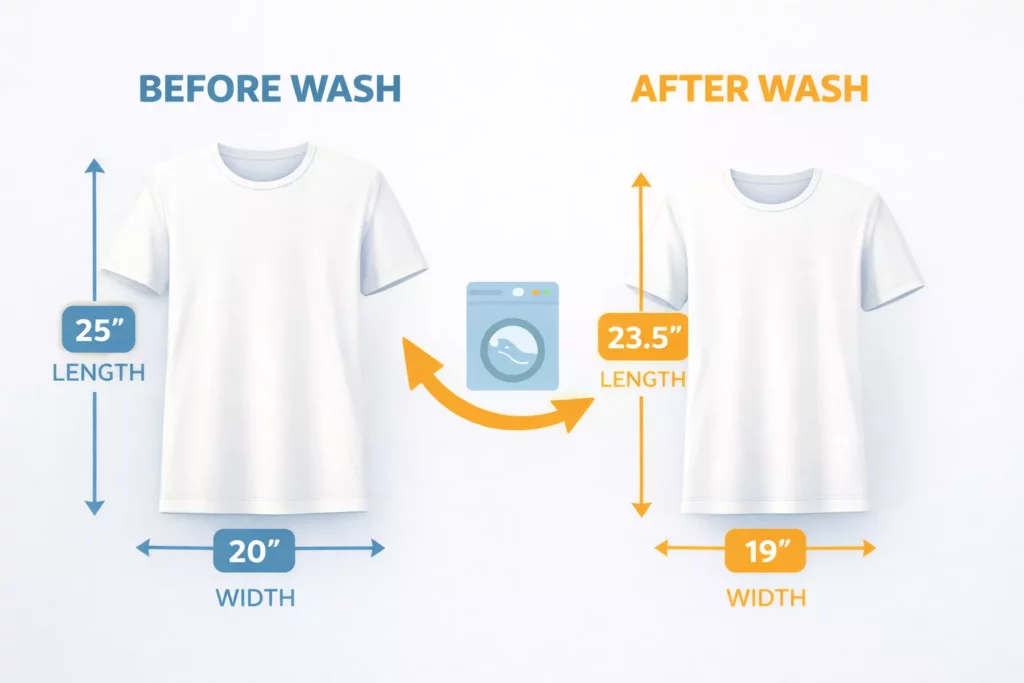
Fabric Shrinkage in the Global Apparel Industry
The global textile industry produces over 100 million tons of fiber annually, and dimensional stability remains one of the most important quality control factors in apparel production.
Industry sourcing reports show that fabric-related issues such as shrinkage, pilling, and color fading account for a large share of garment returns in the apparel industry. Because of this, most apparel brands conduct fabric shrinkage testing before approving bulk production to ensure consistent sizing and product quality.
What Is Fabric Shrinkage?
Fabric shrinkage is the reduction in fabric dimensions after washing, steaming, heat exposure, or other finishing and care processes. In simple terms, the fabric becomes smaller than it was before.
Shrinkage may happen in:
- Length direction
- Width direction
- Both directions at the same time
In apparel manufacturing, shrinkage is usually measured as a percentage. If a fabric sample becomes noticeably smaller after a wash test, the shrinkage percentage helps explain how much dimensional change happened.
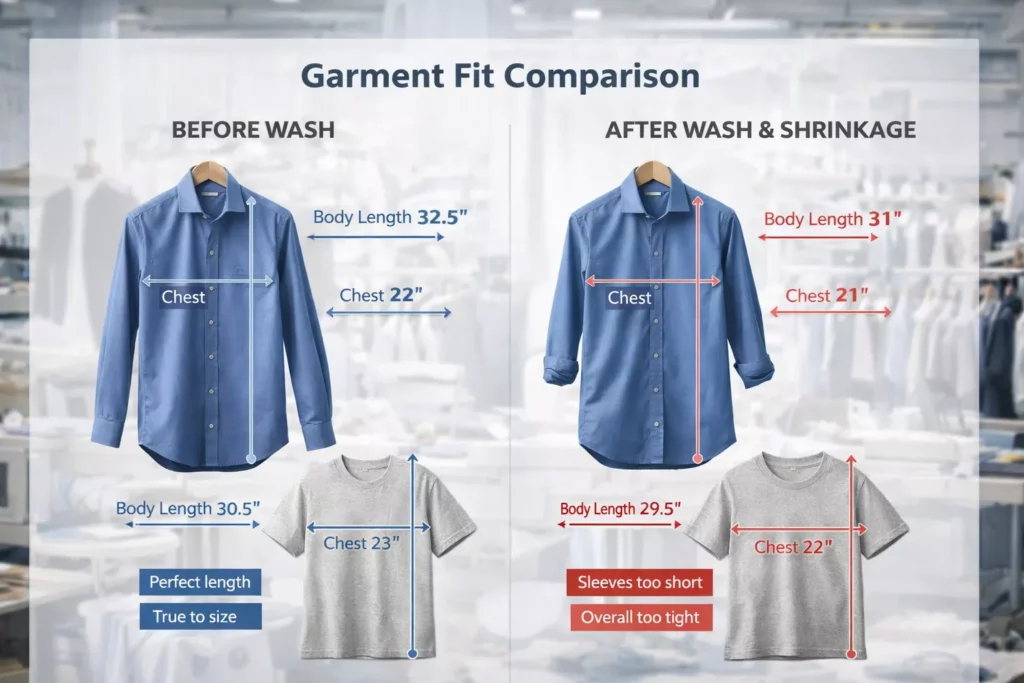
For example, if a knitted cotton fabric shrinks in body length after washing, the finished t-shirt may end up shorter than planned. If a woven shirt fabric shrinks across the width, the chest measurement may tighten after laundering. In denim, shrinkage can affect inseam, waist, and overall fit. In activewear, shrinkage can affect compression balance and garment recovery.
Shrinkage is not only a technical textile issue. It is a product performance issue because customers experience it directly.
Why Fabric Shrinkage Matters in Apparel Manufacturing
Shrinkage matters because apparel sizing depends on stability. If fabric dimensions change too much after washing or finishing, garment measurements change too. That creates multiple commercial and quality problems at the same time.
Shrinkage can affect:
- garment length
- sleeve length
- chest or waist measurements
- overall fit consistency
- size grading accuracy
- retailer compliance
- return rates
- customer trust
A t-shirt that loses body length after one wash may be seen as low quality even if the stitching is perfect. A woven shirt that tightens across the chest may no longer match the approved size chart. A fleece hoodie that shrinks more than expected may create complaints about both fit and comfort. In children’s wear, shrinkage can be especially damaging because sizing expectations are already sensitive.
From a manufacturing perspective, shrinkage also affects pattern making and bulk cutting. If shrinkage is not known early, factories may cut garments using measurements that look correct before washing but become incorrect afterward. That is why shrinkage control needs to be handled before bulk production, not after goods are already packed.
What Is The ISO Standard For Fabric Shrinkage?
Understanding fabric may shrink is important for fabric shrinkage control; standards like iso 3759 guide testing so manufacturers produce quality fabrics that, when cut and sewn, retain dimensions according to fiber type. The way a textile is made — weaving or knitting — and whether its fibers are stretched during production affects how much it will change after the first wash. Manufacturers must choose the right yarns and right materials when selecting the right construction to meet performance targets and meet consumer expectations.
Testing considers full garment and full width samples, since mechanical stress and mechanical agitation during laundering practices cause different shrinkage in different fibers, producing a visible difference between the original measurements and the post-wash garment; manufacturers should also instruct customers to follow the care instructions to minimize unexpected changes.
What Causes Fabric Shrinkage?
Fabric shrinkage happens for several reasons, and the cause is not always the same across every fabric type. In apparel manufacturing, shrinkage usually comes from a combination of fiber behavior, yarn tension, knitting or weaving tension, wet processing, heat exposure, and finishing quality.
The most common causes include:
Fiber Relaxation
Some fibers are under tension during spinning, knitting, weaving, dyeing, or finishing. When the fabric is later washed or heated, that tension relaxes and the fabric contracts.
Moisture and Heat Response
Certain fibers react strongly to water, heat, and agitation. Cotton, rayon, and some regenerated cellulosic fabrics are especially known for dimensional changes if not stabilized properly.
Knitting and Weaving Tension
Knitted fabrics often show more shrinkage risk than woven fabrics because loop structures can relax significantly after washing. Woven fabrics can also shrink, especially if tension was not balanced or finishing was weak.
Finishing Problems
If the mill does not compact, set, or stabilize the fabric correctly, shrinkage may remain too high. Poor finishing is one of the most common preventable causes in production.
Garment Washing and Consumer Care
Some garments undergo washing after sewing, while others are sold unwashed and then first exposed to laundering by the customer. If the brand did not account for that, shrinkage complaints appear after sale.
Shrinkage is rarely random. It usually reflects something that could have been understood, tested, and managed earlier.
How To Calculate Fabric Shrinkage?
Understanding fabric shrinkage is essential in the fashion industry because fabric shrinkage refers to the change in size that occurs after washing and drying. To determine how much shrinkage that occurs, laboratories follow aatcc test methods and measure the percentage of shrinkage on a roll of fabric. Shrinkage rate can vary by types of fabrics, with fibers like cotton and loosely knit materials more prone to shrinkage, while tightly woven goods shrink less.
To calculate the amount of shrinkage, measure the fabric before and post-wash, then divide the difference by the original length to get the percentage of shrinkage. Consider tension of the fabric during the production process and exposure to heat in washing machines or dryers, since shrinkage due to heat is common. Shrinkage can occur unevenly, and shrinkage is a common issue in garments.
To reduce problems, follow steps to prevent fabric shrinkage such as pre-shrinking the fabric, washing in cool water and instead of using a dryer air-dry, which can help to prevent shrinkage. Account for shrinkage in patternmaking to account for shrinkage and ensure products meet specific shrinkage standards by referencing a fabric shrinkage standard. Knowing how much a fabric will change during fabric during production and after care prevents shrinkage in the garment that can lead to returns and waste.
How To Care for Shrunk Fabrics?
To care for shrunk fabrics, begin by treating the item gently: fill a basin with lukewarm water, add a mild conditioner or gentle detergent, and soak for 15–30 minutes to relax the fibers. Avoid agitation and rinse lightly to remove residues.
After soaking, press out excess water without wringing and place the garment between clean towels to absorb moisture. While damp, carefully stretch and reshape the fabric back toward its original dimensions, securing edges with pins on a flat surface if needed. Use weight or gentle tension rather than harsh pulling.
Finish by drying flat away from direct heat or sunlight; avoid the dryer which causes further shrinkage. For delicate or stubborn items, try light steam from a distance or seek professional cleaning. Regularly follow care labels and launder similarly colored items in warm or cold water to prevent repeat incidents.
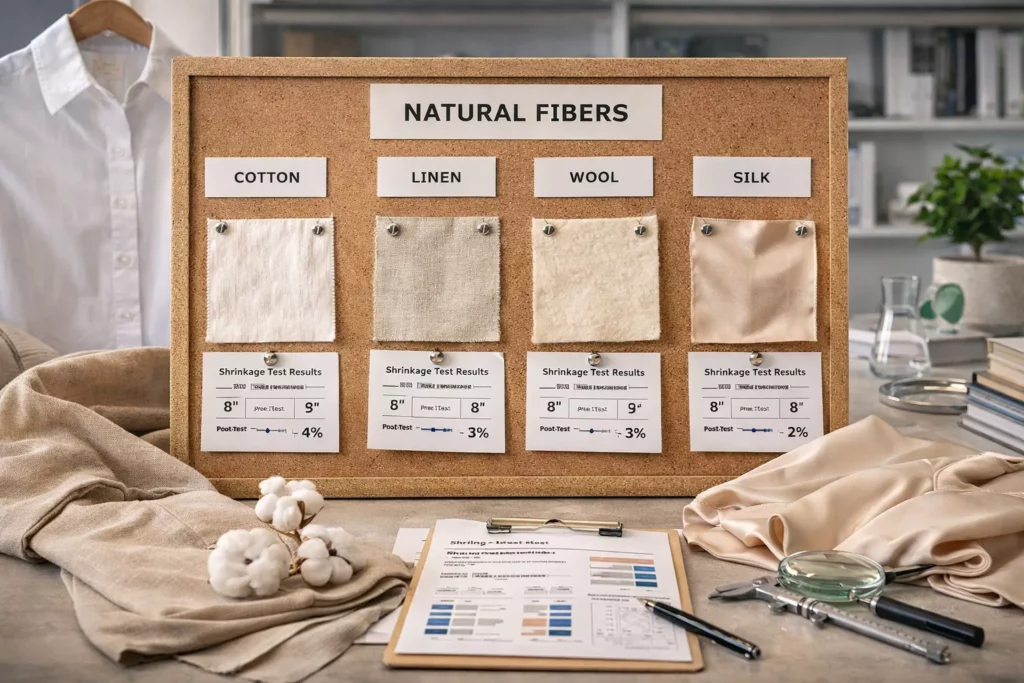
Natural Fibers and Shrinkage Risk
Natural fibers are widely used in apparel because they offer softness, comfort, and breathability. But many natural fiber fabrics also require stronger shrinkage control.
Cotton
Cotton is one of the most common shrinkage-sensitive fibers in apparel manufacturing. Cotton fabrics, especially knits, often shrink because of loop relaxation and fiber behavior after washing. Cotton jersey, fleece, rib, and French terry need careful testing and finishing control.
Linen
Linen can also shrink if not processed correctly. It is often used in shirts, dresses, summer trousers, and resortwear, so dimensional stability is important, especially in relaxed woven garments.
Wool
Wool shrinkage can behave differently depending on processing. Wool may shrink or felt under certain wash conditions, especially if care instructions are not followed properly. In apparel production, wool fabrics require strong wash and handling control.
Silk
Silk can also show dimensional changes depending on weave, finishing, and care process. Because silk garments are often premium, even small shrinkage issues can create strong customer dissatisfaction.
Natural fibers are not automatically unstable, but many of them need proper finishing, wash testing, and garment development control before production approval.
Synthetic Fibers and Shrinkage Risk
Synthetic fabrics are often considered more dimensionally stable than many natural fibers, but that does not mean shrinkage can be ignored. Synthetic fabrics can still shrink, distort, or change shape under heat and process stress.
Polyester
Polyester usually offers good dimensional stability compared with cotton or rayon, which is one reason it is so common in performance apparel and uniforms. However, polyester fabrics can still react to improper heat setting or finishing errors.
Nylon
Nylon is widely used in activewear, swimwear, and technical garments. It can behave well when processed correctly, but heat sensitivity and fabric construction still matter.
Spandex Blends
Stretch fabrics containing elastane or spandex need close attention because shrinkage in the base fiber combined with recovery behavior in the elastic component can create unexpected fit changes. Activewear and leggings are especially sensitive to this issue.
Acrylic
Acrylic fabrics used in knitwear and winter products may also show dimensional or shape-related changes depending on structure and finishing quality.
Synthetic fabrics usually reduce some shrinkage risks, but they do not remove the need for proper testing. In many cases, mixed-fiber or performance fabrics can create more complex shrinkage behavior because multiple fiber responses are working together.
Knit Fabrics Usually Need More Shrinkage Attention
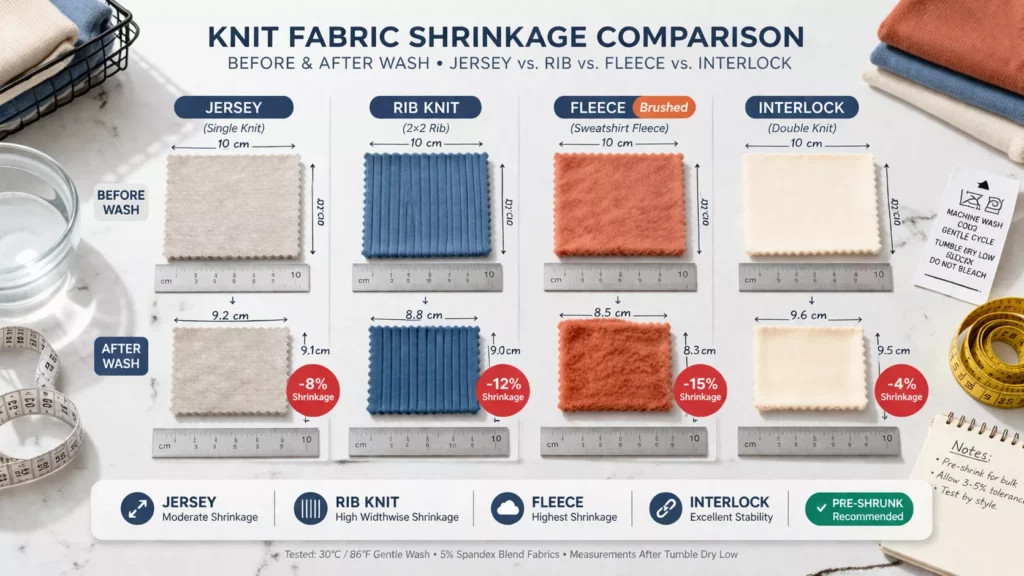
In modern apparel production, knit fabrics usually require more shrinkage control than woven fabrics because knitted structures are more relaxed and elastic by nature. The loop construction of jersey, rib, fleece, and interlock makes knit fabrics especially vulnerable to dimensional change if finishing is not strong enough.
Common knit categories affected by shrinkage include:
- single jersey t-shirts
- rib tops and tanks
- fleece hoodies
- French terry sweatshirts
- interlock basics
- knit dresses and loungewear
When knit fabrics shrink, garment length is often one of the first visible problems. Body width can also change, but vertical shrinkage often creates the strongest customer complaint because shirts look shorter after wash.
Knits also need attention to spirality or twisting behavior, especially in jersey. A garment may not only shrink. It may also twist after wash if fabric balance and finishing are poor.
Because knit fabrics are used in so many casualwear and basics categories, shrinkage control in knits is one of the most important parts of quality assurance for modern apparel brands.
Woven Fabrics Can Shrink Too, but in Different Ways
Woven fabrics are generally more stable than knits because they are built from interlaced yarns rather than loops. But woven fabrics still shrink, especially if yarn tension, fiber content, or finishing quality is not controlled well.
Common woven categories where shrinkage matters include:
- poplin shirts
- rayon dresses
- linen trousers
- twill workwear
- denim
- soft woven fashion tops
Woven shrinkage often affects:
- body width and chest measurements
- sleeve length
- inseam and outseam
- garment drape
- button placket alignment
- after-wash fit balance
In woven garments, even moderate shrinkage can create strong visual issues because structure is more obvious. A shirt that tightens after wash may pull at the chest. A woven dress may become shorter than intended. A pair of trousers may lose inseam length and become harder to wear.
This is why woven fabric stability should also be reviewed carefully during development and wash testing.
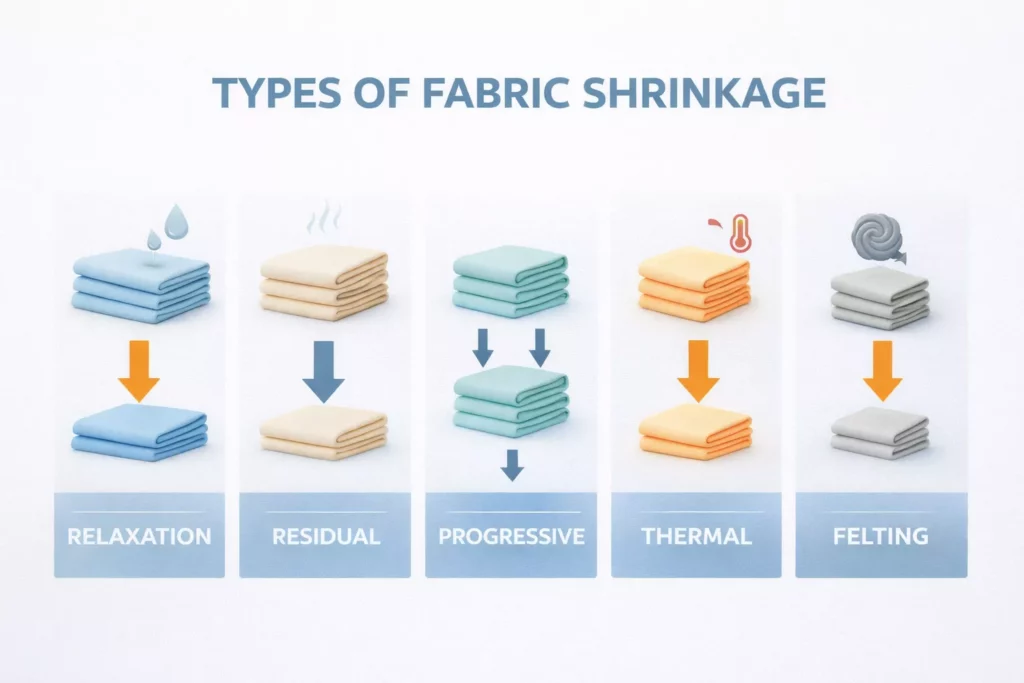
Common Shrinkage Types in Production
Shrinkage is not always one simple number. In production, different types of shrinkage behavior may appear depending on the fabric and process.
Relaxation Shrinkage
This happens when fabric tension is released after washing or wet processing. It is common in cotton knits and other fabrics produced under tension.
Residual Shrinkage
This is the shrinkage remaining in the fabric after finishing. It is often the key concern in product testing because it predicts how the customer garment may change after washing.
Progressive Shrinkage
This occurs over multiple wash cycles rather than all at once. A garment may look acceptable after one wash but continue shrinking slightly over time.
Thermal Shrinkage
This happens due to heat exposure during production or customer care, especially in some synthetic fabrics or blended materials.
Felting or Fulling-Related Shrinkage
This is more common in wool-related products where moisture, heat, and agitation can tighten the structure significantly.
Understanding the type of shrinkage helps brands and factories decide whether the solution should focus on fabric finishing, heat-setting, wash process, pattern adjustment, or care instruction control.
Understanding Fabric Shrinkage
understanding fabric shrinkage is essential in the fashion industry, because fabric shrinkage refers to the reduction in size that a roll of fabric or finished piece may experience. Since shrinkage is a common outcome when fabric during production or laundering, designers must use a fabric shrinkage standard to determine how much change is acceptable and to meet specific shrinkage requirements. The amount of shrinkage and the exact shrinkage that occurs will vary, because shrinkage can vary with fiber content and weaving, and shrinkage can occur unevenly across a piece.
To calculate fabric shrinkage, measure before and after wetting or processing to accurately account for shrinkage in patterns; otherwise, shrinkage can lead to fit problems or waste. Since shrinkage is a natural response influenced by tension of the fabric and finishing, controlling the tension of the fabric and following proper steps to prevent fabric shrinkage — such as preshrinking and correct finishing — will help to prevent shrinkage and ensure the final shrinkage in the garment is within expected limits.
Shrinkage Risk by Fabric Type
| Fabric Type | Shrinkage Risk | Common Garments |
| Cotton | High | T-shirts, hoodies |
| Rayon / Viscose | High | Dresses, blouses |
| Linen | Moderate | Summer shirts, trousers |
| Wool | Moderate | Sweaters, coats |
| Polyester | Low | Sportswear, uniforms |
| Nylon | Low | Activewear, swimwear |
How Shrinkage Is Tested in Apparel Production
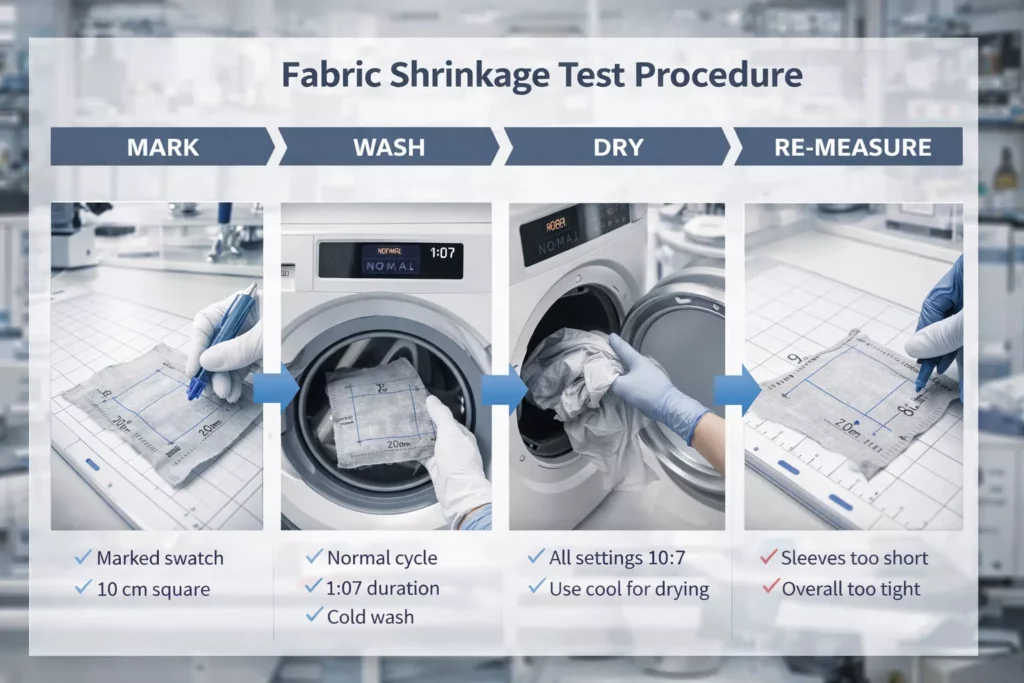
Shrinkage testing is one of the most important quality steps before bulk approval. It helps predict how the fabric will behave after washing and whether the garment measurements will still meet specification.
A typical shrinkage test process often includes:
- cutting a test swatch or fabric sample
- marking measured points or a grid on the fabric
- washing the sample according to the intended care method
- drying it according to the test standard or product care expectation
- Re-measuring length and width after processing
- calculating percentage change
In garment production, the test may be done at fabric stage, garment stage, or both depending on product category. Many brands prefer testing before bulk production so they can confirm whether the fabric is safe to proceed.
For products with wash-sensitive behavior, repeated tests may be necessary. If the brand intends the garment to be machine washed by consumers, the test should reflect a realistic care method rather than an overly gentle lab-only scenario.
The purpose of shrinkage testing is not only to find defects. It is to create control before mass production starts.
What Is an Acceptable Shrinkage Level?
There is no one universal shrinkage percentage that fits every product category. Acceptable shrinkage depends on fabric type, garment use, buyer requirement, and market expectation. But in general, apparel brands want shrinkage to stay within a controlled tolerance that does not damage fit, comfort, or product appearance.
Acceptable shrinkage often depends on:
- whether the fabric is knit or woven
- whether the garment is washed before sale
- whether the product is basic, premium, or performance-focused
- whether buyer-specific quality standards apply
- whether the size specification already accounts for expected after-wash behavior
In many practical manufacturing situations, small controlled shrinkage may be tolerated if it was anticipated during development and built into the garment spec. The bigger problem is uncontrolled or unexpected shrinkage that pushes measurements outside acceptable range after wash.
For example, if a brand develops a cotton t-shirt with expected wash behavior in mind, slight shrinkage may be manageable. But if the same t-shirt loses too much body length unexpectedly, the garment becomes a quality failure.
The best approach is not to memorize one universal number. It is to define acceptable shrinkage clearly for the product category and test against that target before bulk approval.
Why Shrinkage Must Be Checked Before Bulk Production
One of the costliest mistakes in apparel manufacturing is discovering shrinkage problems after bulk garments are already produced. At that point, the factory may have already cut, sewn, packed, or even shipped the order. Fixing the issue becomes expensive, slow, and sometimes impossible.
Pre-bulk shrinkage control is essential because it allows the team to:
- confirm fabric stability before cutting
- adjust patterns if needed
- reject unsuitable fabric early
- change finishing or washing method
- update care instructions if required
- protect final garment measurements
This is especially important for categories like t-shirts, fleece tops, dresses, denim, uniforms, and children’s products where fit consistency strongly affects customer satisfaction.
Fabric shrinkage should be treated as a pre-production checkpoint, not a final-stage surprise. Strong mills, factories, and brands usually understand this. Weak production systems often discover the issue too late because testing was rushed or ignored.
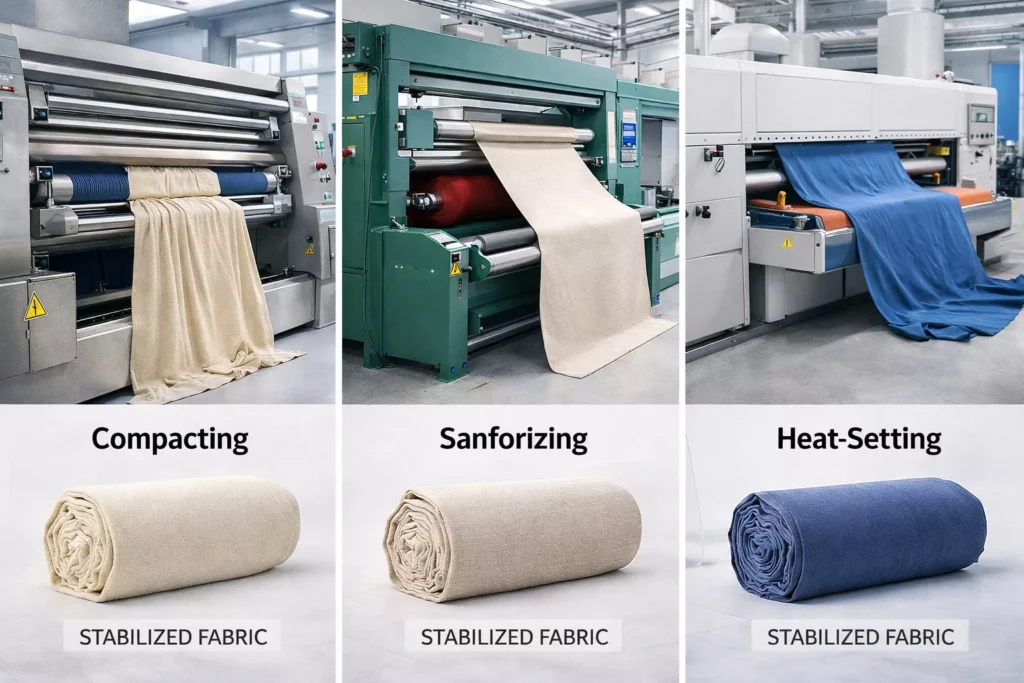
Fabric Finishing Plays a Huge Role in Shrinkage Prevention
Finishing is one of the most important tools for reducing shrinkage risk. Even good fiber and yarn cannot fully protect a fabric if finishing is weak or inconsistent.
Important finishing processes may include:
- compacting
- sanforizing
- heat-setting
- pre-shrinking
- washing stabilization
- relaxing and drying under controlled conditions
Compacting
Common in knit fabrics, compacting helps reduce residual shrinkage by mechanically compressing and stabilizing the fabric.
Sanforizing
Common in woven fabrics, especially cotton and denim-related programs, sanforizing helps control shrinkage by pre-conditioning the fabric.
Heat-Setting
Especially important in synthetic and stretch fabrics, heat-setting helps stabilize fabric shape and reduce unwanted dimensional change.
If the mill finishing is poor, the factory may struggle later no matter how good the sewing quality is. That is why brands should evaluate mill capability, not just fabric appearance.
Common Fabric Shrinkage Testing Methods
| Test Method | Purpose |
| Wash test | Measures shrinkage after laundering |
| Steam test | Evaluates shrinkage under heat exposure |
| Relaxation test | Measures dimensional change after fabric tension release |
| Industrial wash simulation | Tests the shrinkage under commercial laundry conditions |
Pattern Adjustment and Shrinkage Allowance
In some production systems, expected shrinkage is built into the garment pattern or spec. This means the factory cuts the garment slightly larger so that after washing or finishing it reaches the intended final measurement.
This method can work well, but only if shrinkage behavior is already known and controlled. Otherwise, pattern adjustments become guesswork.
Shrinkage allowance is most useful when:
- the product has predictable residual shrinkage
- fabric tests are stable and repeatable
- the wash process is controlled
- the final garment spec is based on after-wash measurement
This is common in some knitwear, washed garments, and denim categories. But it should never be used as a substitute for proper shrinkage prevention. The goal is still to stabilize the fabric as much as possible, not to accept weak fabric control and hope pattern adjustment fixes everything.
Pattern correction only works when testing data is reliable.
Garment Washing Can Help Control Shrinkage Before Sale
For some product categories, garment washing before sale can reduce customer-facing shrinkage risk. This approach is common in categories where brands want the garment to already experience major dimensional change before the customer buys it.
Garment washing may be used for:
- washed t-shirts
- denim
- fleece products
- casual tops
- soft fashion basics
When done correctly, garment washing can help:
- relax the garment before sale
- improve handfeel
- reduce residual shrinkage risk
- create a more stable customer fit experience
However, garment washing also adds process cost, color variation risk, and finishing complexity. It must be controlled carefully, especially in large-volume production.
This method is not right for every product, but for some categories it is one of the most practical shrinkage management strategies available.
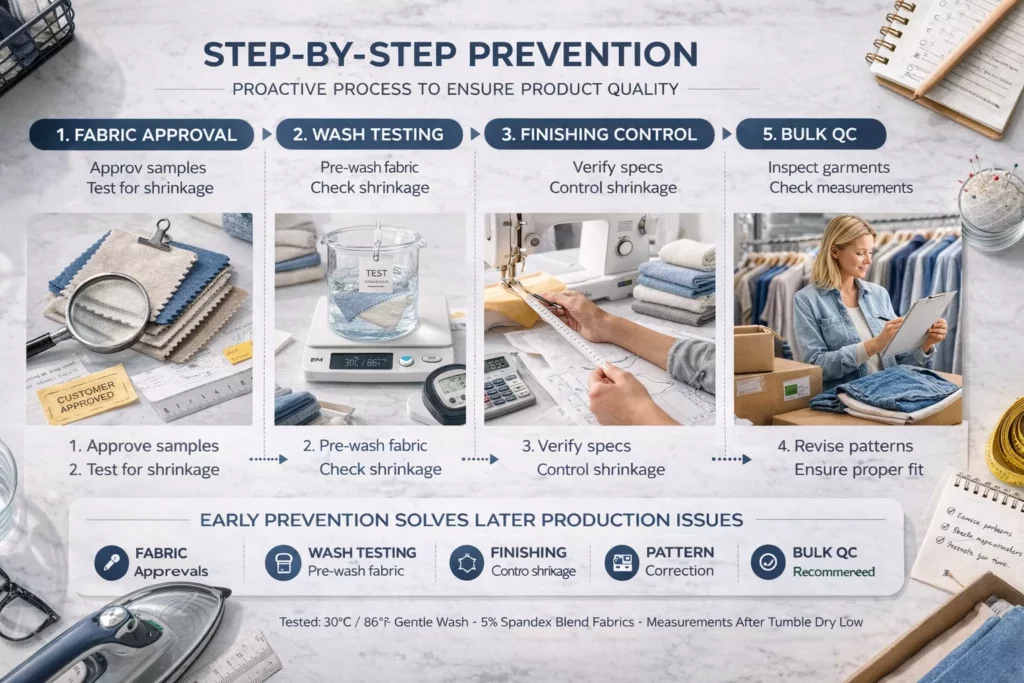
How to Prevent Fabric Shrinkage in Production
Preventing shrinkage in production requires a system, not one isolated action. The strongest apparel factories and brands control shrinkage across fabric sourcing, testing, finishing, pattern development, and QC.
Here are the most important prevention steps:
Approve Fabric Carefully
Do not approve fabric based only on color or handfeel. Confirm fiber content, construction, finishing, and shrinkage test results.
Test Before Bulk
Run shrinkage tests before production approval, especially on shrinkage-sensitive categories like cotton knits, rayon wovens, fleece, and washed garments.
Work With Reliable Mills
Fabric quality starts at mill level. Choose suppliers that understand compacting, sanforizing, heat-setting, and dimensional control.
Confirm Finishing Standards
Ask whether the fabric has been compacted, pre-shrunk, or otherwise stabilized. Match this information to the category.
Align Patterns With Real Fabric Behavior
If controlled residual shrinkage exists, build that into the size development and approval process.
Monitor Bulk Consistency
Do not assume bulk fabric always matches sample fabric. Test bulk if needed, especially when lots or suppliers change.
Align Care Instructions With Reality
If the fabric requires special care to maintain dimensions, make sure labels and product communication reflect that honestly.
Shrinkage prevention works best when every stage supports the same quality goal.
Common Shrinkage Mistakes in Manufacturing
Shrinkage problems usually become expensive because of repeated preventable mistakes. Some of the most common include:
- approving fabric without wash testing
- relying only on supplier verbal claims
- ignoring mill finishing quality
- treating sample fabric and bulk fabric as identical without checking
- changing fabric source late in development
- rushing bulk cutting before final test data is reviewed
- using weak care labels that do not match product behavior
- assuming higher price means lower shrinkage risk
- overlooking spirality in knit garments
- failing to communicate shrinkage expectations between the buyer and the factory
Many of these issues are not difficult to fix. They simply require stronger discipline earlier in the process. Shrinkage control is often less about advanced science and more about consistent quality management.
Fabric Shrinkage and Customer Care Instructions
Even strong production control needs support from accurate care instructions. If the brand expects a garment to perform well in home laundering, the care label should match realistic use.
Care instructions affect shrinkage risk because customers may:
- wash hotter than expected
- tumble dry aggressively
- use strong agitation
- ignore delicate handling recommendations
This is especially important for:
- cotton basics
- rayon dresses
- wool knitwear
- stretch performance garments
- premium tops and fashion pieces
A misleading care label creates avoidable complaints. If a fabric behaves best under gentle care, that needs to be communicated clearly. At the same time, brands should be realistic. If the target customer expects easy-care washability, the product should be developed to support that expectation whenever possible.
Strong shrinkage prevention is not only about lab testing. It is also about setting the customer up for the right wash behavior.
How Brands and Manufacturers Should Work Together
Shrinkage control is most successful when the brand, mill, and factory communicate clearly. If one side assumes the other is managing the issue, problems often slip through.
A good working system usually includes:
- brand defines product expectations and acceptable dimensional stability
- mill provides accurate finishing and test information
- factory confirms fabric behavior before cutting
- QA team reviews shrinkage results with sample and bulk approval
- merchandisers track whether fabric changes occurred during sourcing
- production team aligns final measurements with after-wash reality
This teamwork matters because shrinkage is not only a mill issue or only a sewing issue. It sits across the whole product development and manufacturing chain. When communication is weak, shrinkage becomes a blame game. When communication is strong, shrinkage becomes a manageable production parameter.

A Simple Shrinkage Prevention Checklist for Beginners
If you are new to apparel development, use this simple checklist before approving a fabric for production:
Before Sampling
- Confirm fiber content
- Confirm knit or woven structure
- Ask whether the fabric is compacted, pre-shrunk, or heat-set
During Sampling
- Wash test the fabric or garment
- Review length and width change
- Check spirality or distortion if knit
Before Bulk Production
- Confirm bulk fabric matches approved sample
- Re-test if lot changes or source changes
- Align pattern measurements with expected after-wash behavior
Before Shipment
- Verify final garments still meet measurement tolerance
- Confirm care labels match realistic garment behavior
This kind of checklist does not remove all risk, but it greatly reduces preventable mistakes.
ApparGlobal
Many apparel brands reduce shrinkage-related quality risks when they work with manufacturing partners that understand fabric sourcing, shrinkage testing, pattern planning, wash development, and apparel quality control. Companies such as ApparGlobal help clothing brands align fabric behavior with product category, fit expectations, and production workflows so shrinkage prevention becomes more practical, more consistent, and more production-ready from the beginning.

Conclusion
Fabric shrinkage is one of the most important quality factors in apparel manufacturing because it directly affects fit, sizing, product consistency, and customer satisfaction. It can happen in natural fibers, synthetic blends, knit fabrics, woven fabrics, and washed garments, but the root problem is often not the fiber alone. It is how the fabric was processed, tested, and controlled before bulk production.
The good news is that shrinkage is usually manageable when brands and manufacturers treat it seriously early enough. Strong fabric approval, accurate testing, reliable finishing, realistic care instructions, and clear communication across the supply chain can reduce shrinkage problems significantly.
So, fabric shrinkage and how to prevent it in production is not just a technical factory issue. It is a core product development discipline. When brands understand that, they protect product quality before the customer ever notices a problem.
Read more about: Fabric Guide: Different Types of Fabric & How to Use Each Type
Read more about: Fabric GSM: Understanding What GSM Means in Fabric