

Wholesale vs Retail: Pricing and Key Differences Explained
The question “Wholesale vs. retail clothing business: which is better?” clearly does not have a straightforward answer. One of the biggest decisions in the fashion industry is not just what to sell, but how to sell it. A clothing brand can build its business through wholesale, where garments are sold in bulk to retailers, boutiques, and distributors, or through retail, where the brand sells directly to the end customer through its own website, store, pop-up, or marketplace presence. Both models can work. Both can be profitable. Both can also become difficult if the founder chooses the wrong model for the product, brand stage, budget, and long-term growth plan.
The better model depends on your margins, your operational capacity, your brand positioning, your target customer, and the speed at which you want to scale. A wholesale clothing business can move larger volumes faster and give access to established retail audiences, but it usually comes with lower margins and less control over the final customer experience. A retail clothing business gives stronger control over branding, pricing, and customer data, but it also requires more work in marketing, fulfillment, customer acquisition, and retention.
For new brands, this decision affects almost everything. It changes your pricing structure, your production planning, your packaging, your content strategy, your inventory model, your cash flow, and even how you design your collection. A product that works well for wholesale may need different margins and line planning than a product built for direct-to-consumer retail. A fashion founder who understands this early usually builds a stronger business system from the beginning.
In this guide, you will learn the real difference between wholesale and retail clothing businesses, how each model works, what the main advantages and disadvantages are, how profit margins compare, and how to decide which business model fits your brand best.

Quick Comparison: Wholesale vs Retail Clothing Business
Wholesale and retail clothing businesses differ mainly in who buys the product first.
- Wholesale clothing business: sells garments in bulk to retailers or distributors who then sell to customers.
- Retail clothing business: sells garments directly to the end consumer through ecommerce stores, physical shops, or marketplaces.
Wholesale usually focuses on higher volume but lower margin, while retail focuses on higher margins but requires direct marketing and customer management.
What Is a Wholesale Clothing Business?
A wholesale clothing business sells garments in bulk to other businesses rather than directly to the final consumer. In this model, the clothing brand or apparel supplier produces or sources products and then offers them to boutiques, department stores, online retailers, distributors, or resellers at a wholesale price. The buyer then marks up the product and sells it to the end customer at retail price.
In practical terms, wholesale is a business-to-business model. The brand’s customer is not the person wearing the garment first. The customer is the retailer or reseller who purchases inventory in volume. This means the clothing business must focus on things like wholesale pricing structure, minimum order quantities, line sheets, merchandising consistency, delivery schedules, and retailer relationships.
A wholesale model is common in many parts of the apparel industry, including women’s fashion, kidswear, basics, accessories, occasionwear, resortwear, and boutique collections. Many clothing businesses use wholesale because it can help move inventory in larger quantities and place the brand in front of audiences that are already shopping at established retail stores.
However, wholesale also changes how the brand must operate. Since retailers need their own profit margin, the brand has less room per unit than it would in direct retail. This means costing discipline, production efficiency, and pricing strategy become extremely important.

What Is a Retail Clothing Business?
A retail clothing business sells directly to the final customer. This can happen through an ecommerce website, a physical store, a pop-up shop, a social commerce setup, or a marketplace where the brand controls the customer-facing offer. In this model, the clothing business owns the product presentation, pricing, packaging, customer communication, and often the overall brand experience.
Retail is usually what many startup founders imagine first. They picture a clothing brand with its own website, its own visual identity, and direct contact with customers. This model can be very powerful because it allows the brand to keep a larger share of the retail price per item. It also provides customer feedback, repeat-purchase opportunities, first-party data, and stronger long-term brand equity when executed well.
But retail is not simply “higher margin, better business.” A direct retail clothing business also has to handle more responsibilities. It must attract traffic, convert visitors, manage fulfillment, respond to customer questions, process returns, run marketing campaigns, and keep the customer experience strong from first click to delivery.
Retail works especially well for brands that want control. It suits fashion founders who care deeply about product storytelling, positioning, customer journey, and long-term audience building. Still, it requires stronger operational effort than many beginners expect.
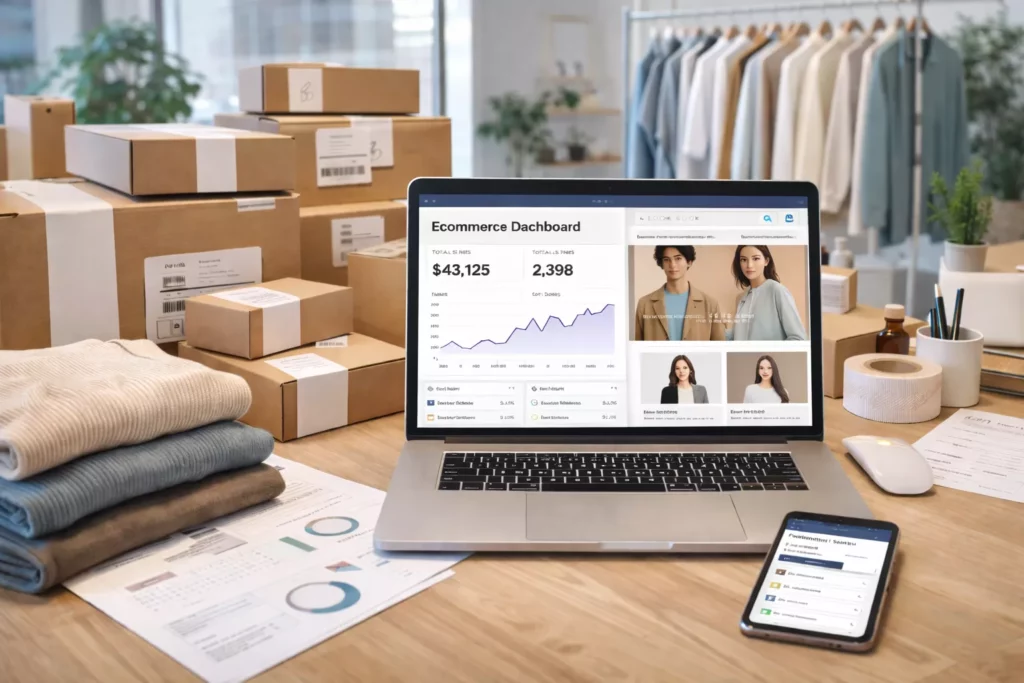
The Core Difference Between Wholesale and Retail
At the most basic level, the difference between wholesale and retail clothing business comes down to who buys from you first.
In wholesale, you sell to another business.
In retail, you sell to the final customer.
That one difference changes almost every business decision.
In wholesale, your job is to convince retailers that your products will sell well in their stores or channels. You need strong sell-through potential, dependable delivery, commercially sensible pricing, and product consistency. The retailer then takes over the final selling process.
In retail, your job is to do both parts yourself. You need to create the product and then market it directly to the customer. That gives you more control over the brand but also means you carry more responsibility for traffic, conversion, fulfillment, and retention.
A good way to think about it is this: wholesale is a distribution-first model, while retail is a customer-relationship-first model. Neither is automatically better. They are simply built around different strengths and demands.
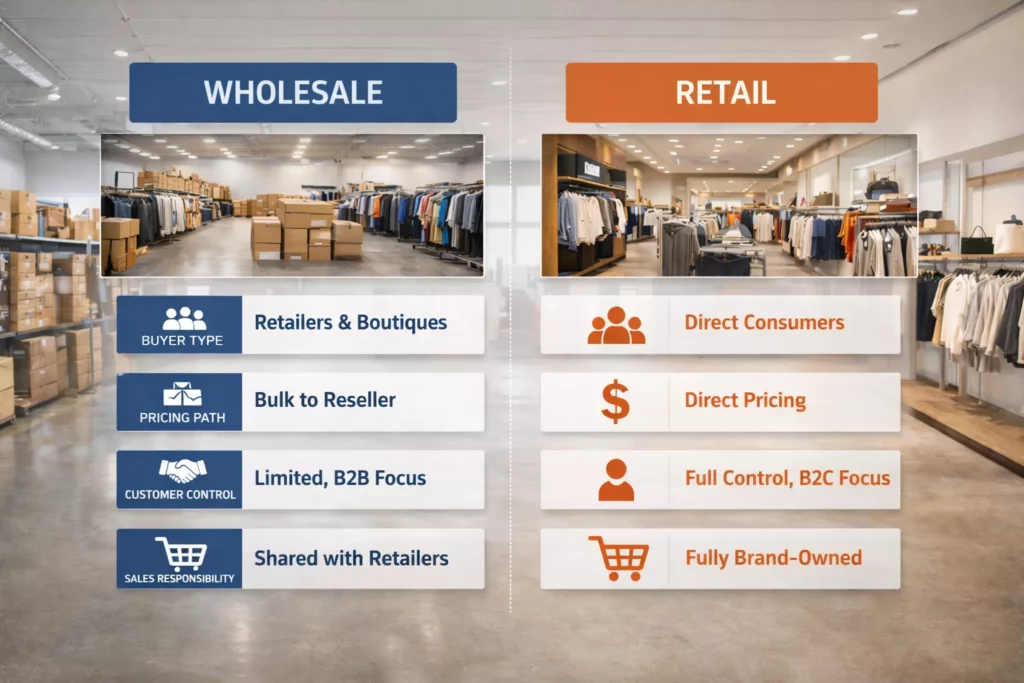
Is Wholesale More Profitable Than Retail?
Wholesale can offer higher margins per unit through volume discounts and lower per-item costs, but profitability depends on many factors; while wholesalers benefit from bulk orders, they often work with thinner markups and rely on scale to generate significant profit.
In contrast, small retail can command higher markups and capture consumer-driven margins, yet it faces higher overheads such as rent, staffing, and marketing. The advantage in retail lies in brand, location, and customer service, which can turn niche products into premium-priced offerings.
Ultimately neither model is universally more profitable: wholesale suits businesses that can efficiently manage logistics and large inventories, while retail rewards those who excel at merchandising and customer relationships. Many successful firms combine both—using wholesale to scale distribution and retail to preserve higher margins—balancing volume and unit profitability to maximize overall returns.
Wholesale vs Retail Clothing Business Comparison
| Factor | Wholesale Clothing Business | Retail Clothing Business |
| Customer type | Retailers or distributors | End consumers |
| Sales volume | Larger bulk orders | Individual customer purchases |
| Profit margin per unit | Lower | Higher |
| Marketing responsibility | Mostly retailer | Brand handles marketing |
| Brand control | Limited | Full control |
| Customer data access | Limited | Direct access |
Wholesale vs Retail Pricing Strategies
In the supply chain, the key difference between channels is who buys and how goods move: selling wholesale means offering products in bulk at a discounted price so buyers can buy in bulk or buying wholesale to resell. In contrast, retail involves selling products directly and directly to consumers through a retail operation or an online store, targeting retail customers.
The difference between wholesale vs retail (the difference between wholesale vs retail or retail vs wholesale) shows that wholesale pricing involves a lower cost per unit and a lower price per item, while retailers add margin and may charge a higher price. Successful businesses combine wholesale and retail pricing with strong wholesale operations, wholesale management, and efficient retail fulfillment. Whether wholesale enterprises, a single retail strategy, or firms that manage both wholesale and retail and selling both wholesale and retail, giving partners access to wholesale can drive volume across retail and wholesale operations.
How the Money Works in a Wholesale Clothing Business
In a wholesale clothing business, revenue usually comes from larger-volume orders placed by retail buyers. A boutique, chain store, or reseller may purchase multiple sizes, colors, and styles at a wholesale rate, then resell them at a higher retail price.
Because the retailer also needs room to profit, the clothing brand’s per-unit revenue is lower than it would be in direct retail. For example, if a final consumer pays $80 retail for a dress, the wholesale brand may have sold that dress to a retailer for a much lower price. That gap is what allows the retailer to run its own business.
This model can still be attractive because volume often compensates for lower margin per unit. A strong wholesale account can move a lot of product at once, which can improve production planning and inventory turnover. Instead of selling one piece at a time through ads and website traffic, the brand may secure a larger order through one buyer relationship.
The challenge is that wholesale margins require careful cost control. If your manufacturing cost is too high, or if your wholesale price is too low, profitability can become tight very quickly. This is why successful wholesale clothing businesses usually understand costing, MOQ planning, delivery timing, and line efficiency extremely well.

How the Money Works in a Retail Clothing Business
In a retail clothing business, the brand sells directly to the customer at the final selling price. That usually creates more room per item than wholesale because there is no retailer margin in between. On paper, this often makes retail look more attractive.
But retail does not automatically mean easy profit. The brand must spend money to generate demand. That may include product photography, ecommerce tools, paid ads, influencer seeding, email marketing, packaging, shipping support, exchanges, returns, and customer service. All of those costs sit closer to the brand rather than being absorbed by a retailer.
So while retail often offers a higher gross margin, it can also create higher operating pressure. A brand may earn more per unit on paper but spend heavily to acquire each sale. This is why strong retail pricing must support not only product cost, but also customer acquisition and retention.
The major advantage is that a successful retail brand can build long-term value more directly. It owns the relationship with the customer, sees feedback immediately, and can increase lifetime value through repeat purchases and brand loyalty. That makes retail very attractive for founders who want to build a direct brand, not just move volume.
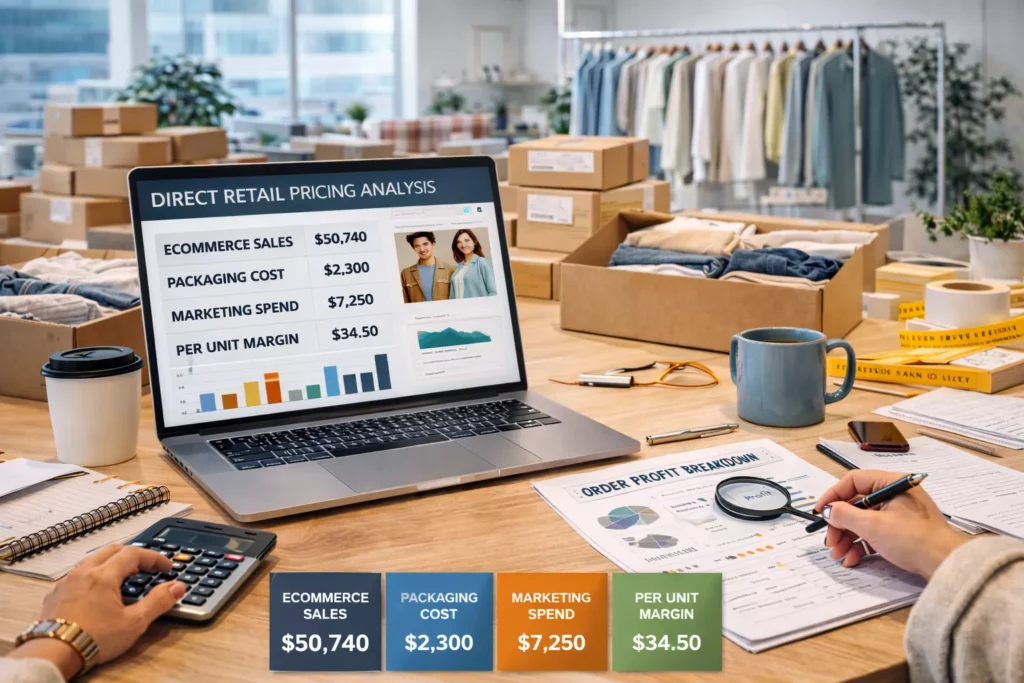
Wholesale Advantages: Why Many Clothing Brands Choose This Model
Wholesale offers several strategic advantages, especially for brands that want to scale distribution through established retail channels.
One major advantage is access to existing customers. Instead of building all customer traffic from scratch, the brand can place its products in stores or online retailers that already have an audience. This can be especially valuable for new fashion labels that want visibility without depending entirely on direct-response marketing.
Another advantage is larger order volume per transaction. One wholesale account may place an order large enough to improve production efficiency and inventory planning. This can help a brand move stock faster and simplify sell-in compared with one-by-one customer orders.
Wholesale can also reduce certain day-to-day retail burdens. The brand may not need to handle each consumer order individually, manage as many customer service inquiries, or process the same level of retail returns in-house, depending on the commercial setup.
In some cases, wholesale can also help validate a collection. If buyers consistently place orders on certain styles, that gives the brand useful commercial feedback.
For brands that are strong in product, manufacturing, and business-to-business sales relationships, wholesale can be a very effective growth channel.

Wholesale Disadvantages: Where the Model Gets Difficult
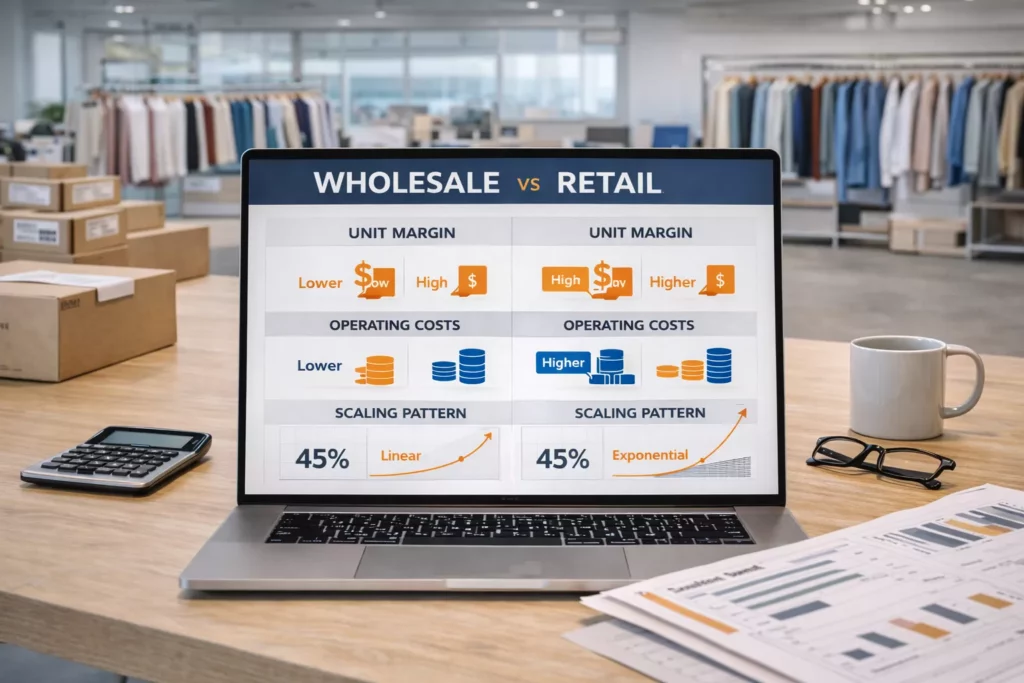
Wholesale is powerful, but it also comes with serious challenges. The biggest issue is usually lower margin per unit. Because retailers need room to mark products up, the brand cannot price wholesale goods as aggressively as it might price direct-to-consumer inventory.
Another challenge is less control over the final brand experience. Once the product enters a retailer’s store or site, the brand may not control product placement, discounting, visual presentation, customer education, or the final selling story. That can weaken brand positioning, especially for labels that depend on storytelling and strong presentation.
Wholesale also creates pressure around delivery reliability. Retailers usually expect on-time shipments, correct labeling, correct assortment, and consistency across orders. If a brand cannot deliver professionally, relationships can break quickly.
Cash flow can also be tricky. Production often needs to be funded before the brand receives full payment from the wholesale customer. That makes working capital and planning extremely important.
And finally, wholesale is competitive. Buyers see many brands. To succeed, your line needs strong product-market fit, clear differentiation, and commercial viability.
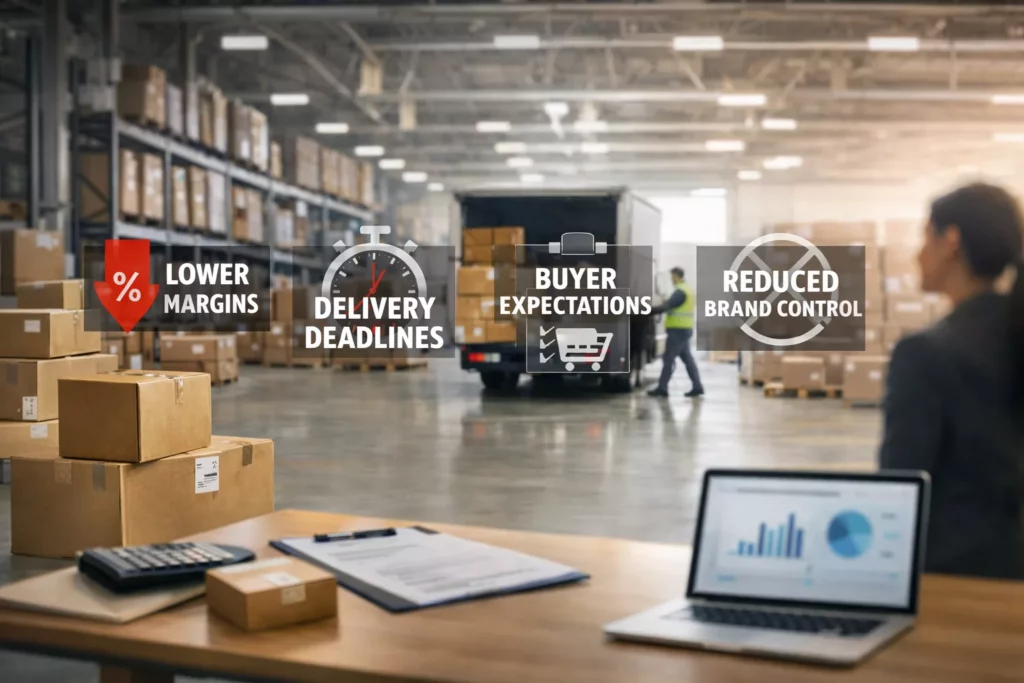
Wholesale Pricing Strategies for Fashion Brands
Wholesale fashion leaders must understand the key difference between wholesale and retail: scale and pricing. The difference between wholesale vs direct-to-consumer models impacts inventory and margins, and the difference between wholesale vs retail flows into how brands price goods. Comparing retail vs wholesale clarifies that wholesale vs retail pricing strategies serve different buyers—buyers buying in bulk versus individual retail customers. Effective wholesale and retail pricing ties into both retail pricing strategies and bulk discounts, while wholesale operations must coordinate with retail operation and retail fulfillment.
Modern brands that manage both wholesale and retail—running an online store and supplying stock to stores—become wholesale enterprises by granting access to wholesale terms and supporting partners. A successful retail strategy acknowledges that wholesale pricing involves a lower cost per unit and therefore a lower price per item, while ensuring margins and brand value when selling both wholesale and retail.
Retail Advantages: Why Direct-to-Consumer Appeals to So Many Founders
Retail clothing businesses appeal to many founders because they offer something extremely valuable: control. A direct brand controls pricing, storytelling, product presentation, packaging, and the overall customer journey. That means the brand can build a stronger emotional connection with buyers and create a more distinctive identity over time.
Retail also allows the business to keep more of the selling price before marketing and operating costs are considered. That can make premium positioning easier if the brand experience is strong enough to support it.
Another huge benefit is customer data and feedback. In retail, the brand sees what people browse, what they buy, which products convert best, what sizes get returned, and how customers talk about the garments. This makes product improvement and future planning more precise.
Retail also supports long-term brand equity. Instead of depending on third-party stores to tell the brand story, the brand builds its own community, its own email list, and its own repeat-customer system. This can become a major long-term advantage if the brand survives the early growth stage.
For founders who care about customer relationship, positioning, and long-term direct brand value, retail is often the most attractive path.
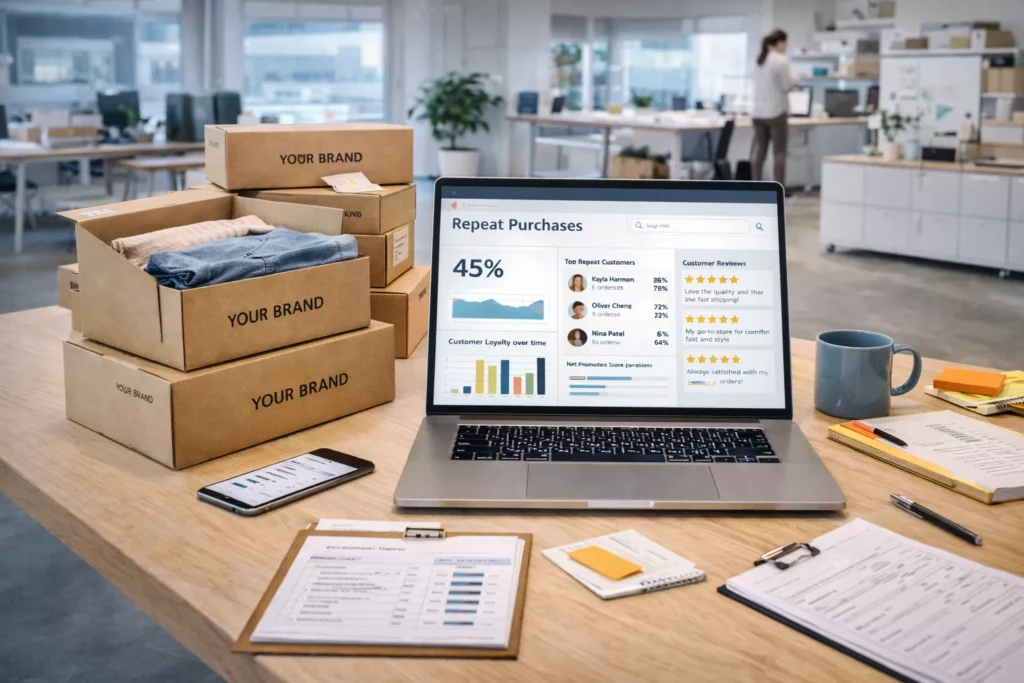
Retail Disadvantages: Why DTC Is Not Automatically Easier
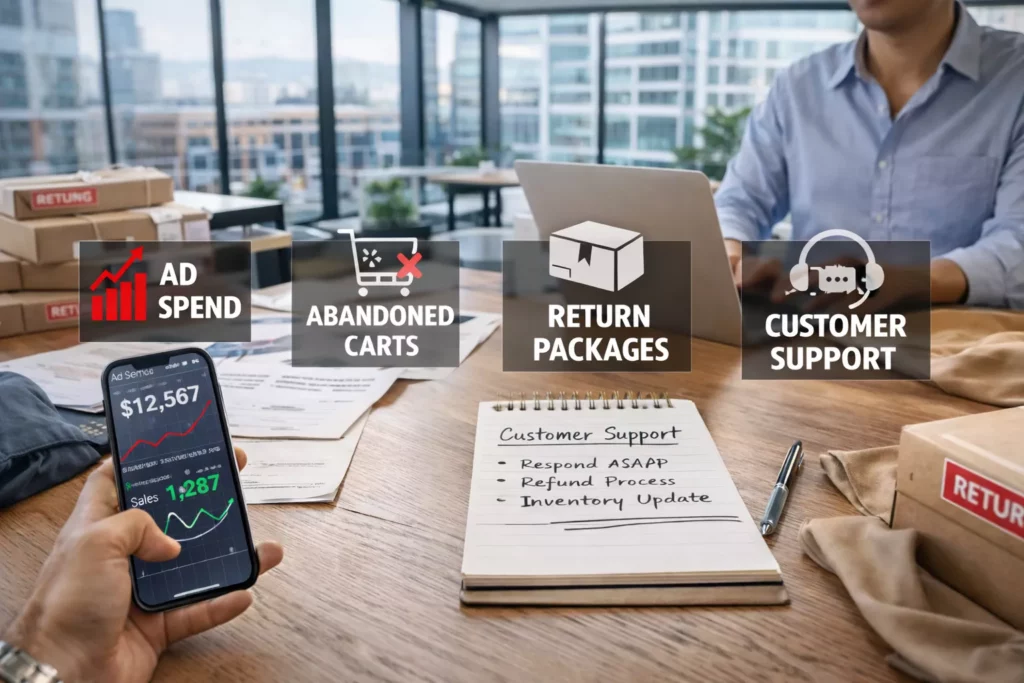
Retail gives control, but it also gives responsibility. A direct-to-consumer clothing brand must generate its own traffic, tell its own story, convert visitors, fulfill orders, manage returns, answer customer emails, and maintain the full selling system.
This means a retail brand often needs:
- stronger marketing execution
- better creative content
- active customer support
- order fulfillment processes
- return management systems
- retention strategy
Customer acquisition can also become expensive. A brand may have beautiful products but struggle to sell profitably if ads are inefficient or organic reach is weak. This is one reason many retail businesses look attractive on gross margin but still face real pressure at the operating level.
Inventory risk can also feel heavier in retail because the brand is waiting for end customers to buy one unit at a time. In wholesale, larger accounts may move that inventory faster. In retail, unsold stock stays closer to the brand.
Retail is often the better long-term brand-building model, but it is not the easier short-term operating model.
Retail and Wholesale Synergy: Maximizing Market Reach
Retail and Wholesale Synergy maximizes market reach by connecting retailers or other businesses with suppliers and by buying products in bulk to reduce cost per unit, but it also depends on an appreciation of the differences between retail and wholesale approaches. Retail companies can offer items at prices lower than retail to partners, strengthening relationships with your retail network while maintaining margins at multiple retail locations. Some firms choose to operate both retail and wholesale arms so they control distribution and brand experience.
Success requires clarity on how wholesale and retail differ, whether you’re buying retail for immediate sale or following a model focused on bulk moves; understanding the differences between wholesale channels helps design what retail businesses need. The wholesale model allows faster turnover through physical retail stores, fulfillment centers, and large wholesale orders. By selling wholesale products alongside retail SKUs and offering products for wholesale, companies reap the benefits of wholesale while pricing some lines higher than wholesale. Blending channels into a coherent strategy for retail expands reach and stabilizes revenue.
Margin Comparison: Wholesale vs Retail Clothing Business
One of the most important differences between wholesale and retail is margin structure.
In retail, the brand usually has more room per unit because it sells at full customer-facing price. This can create stronger gross margins if the brand has the marketing and operational ability to support direct sales efficiently.
In wholesale, the selling price per unit is lower because the retailer also needs margin. That means wholesale businesses often operate on tighter unit economics. However, they may compensate through bigger orders and lower direct customer acquisition burden.
So which model is more profitable? That depends on the full business system.
A retail sale may produce more gross margin on paper, but if the brand spends heavily on ads, shipping support, and returns, net profit may shrink. A wholesale order may produce less margin per unit, but if the brand secures stable large-volume orders with efficient production, total profit can still be attractive.
This is why founders should never ask only, “Which one has higher margin?” They should ask, “Which one creates the healthiest real business model for my brand at this stage?”
Control vs Scale: The Strategic Trade-Off
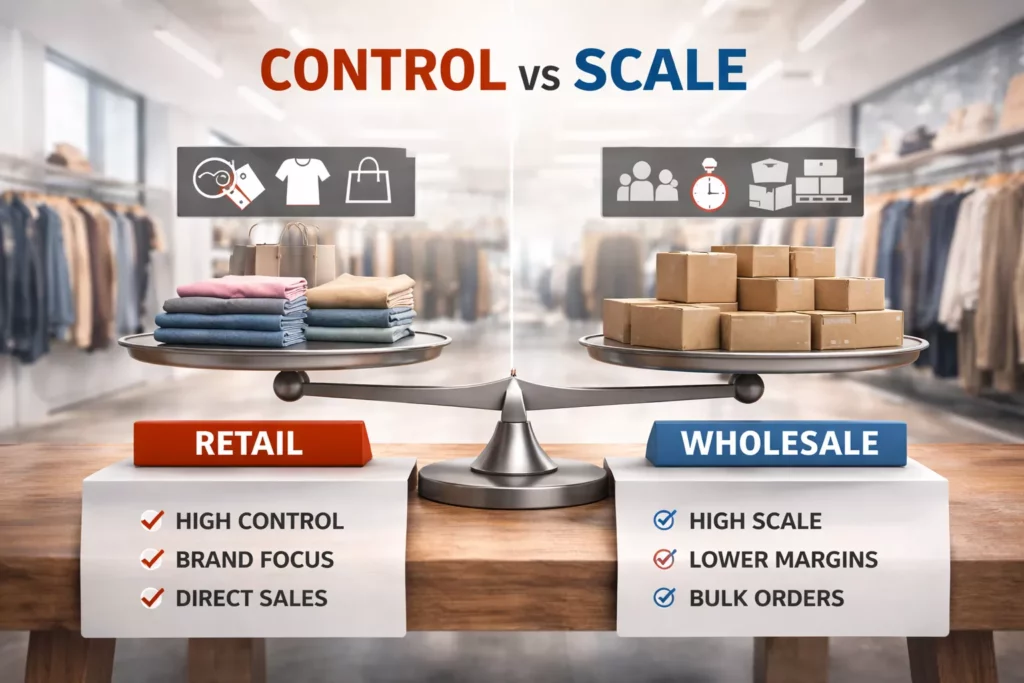
A useful way to understand this decision is to think about control versus scale.
Retail usually offers more control. You own the customer journey, the pricing, the creative direction, and the brand identity. This can be excellent for long-term positioning and customer loyalty.
Wholesale usually offers more immediate distribution scale through external buyers. Your products may reach more locations faster if retail partners support the line well. That can increase visibility and volume without requiring the same direct traffic generation from your side.
So the real trade-off often looks like this:
- Retail: more control, more customer ownership, more work per sale
- Wholesale: more distribution leverage, less control, tighter margin structure
Neither side wins automatically. The better option depends on what the brand needs more right now: control or scale.
A young founder with strong digital marketing capability may thrive in retail. A product-driven brand with boutique-friendly collections and good buyer relationships may do very well in wholesale. Many mature brands eventually build a hybrid strategy because they want both.
Which Model Is Better for Startup Clothing Brands?
For many startup clothing brands, retail is often the more practical starting point because it allows the founder to test product-market fit, gather customer feedback, and build the brand story directly. It is often easier to launch a small DTC operation than to convince wholesale buyers to take a chance on an unknown label.
Retail also helps a new brand learn faster. The founder sees which products sell, what customers say, which price points convert, and where quality or fit issues appear. That kind of learning is extremely valuable in the early stage.
However, not every startup should avoid wholesale. If the founder already has strong retail relationships, a boutique-friendly product line, and enough working capital to support production and delivery expectations, wholesale can work well even early on.
In practice, many new brands begin with retail to validate the line and then explore wholesale later once the product and identity are stronger. That tends to be a more manageable path than trying to jump directly into broad wholesale distribution without brand proof.
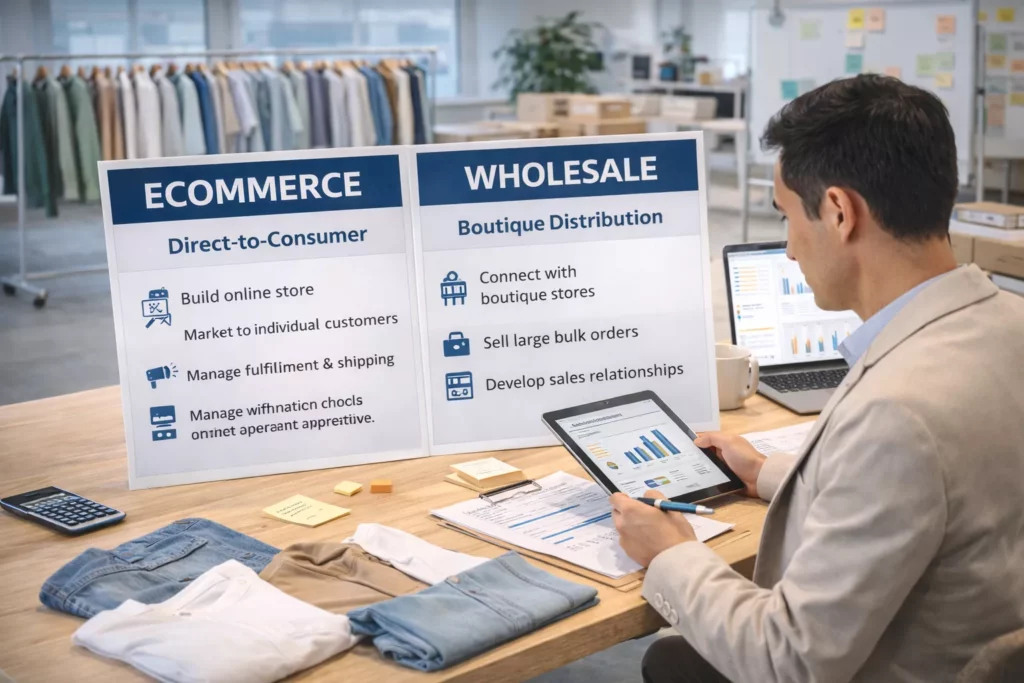
Which Model Is Better for Established Clothing Businesses?
As a clothing business grows, the answer becomes more nuanced. Established brands often benefit from a mixed approach because each channel supports different strengths.
A stronger retail business may continue to use DTC for margin, storytelling, and customer data while also adding selective wholesale for broader reach. A wholesale-led business may eventually build stronger retail channels to improve brand equity and reduce dependence on external buyers.
Established brands are often better positioned to handle channel complexity because they have:
- stronger inventory planning
- better financial controls
- larger marketing systems
- clearer brand identity
- more reliable production
That means the question for established businesses is not always “wholesale or retail?” It is often “what channel mix creates the healthiest growth?”
Still, the decision should remain strategic. If wholesale partners push constant discounting or weaken the brand image, selective retail focus may be better. If DTC acquisition cost becomes too high, carefully chosen wholesale partners may improve reach.

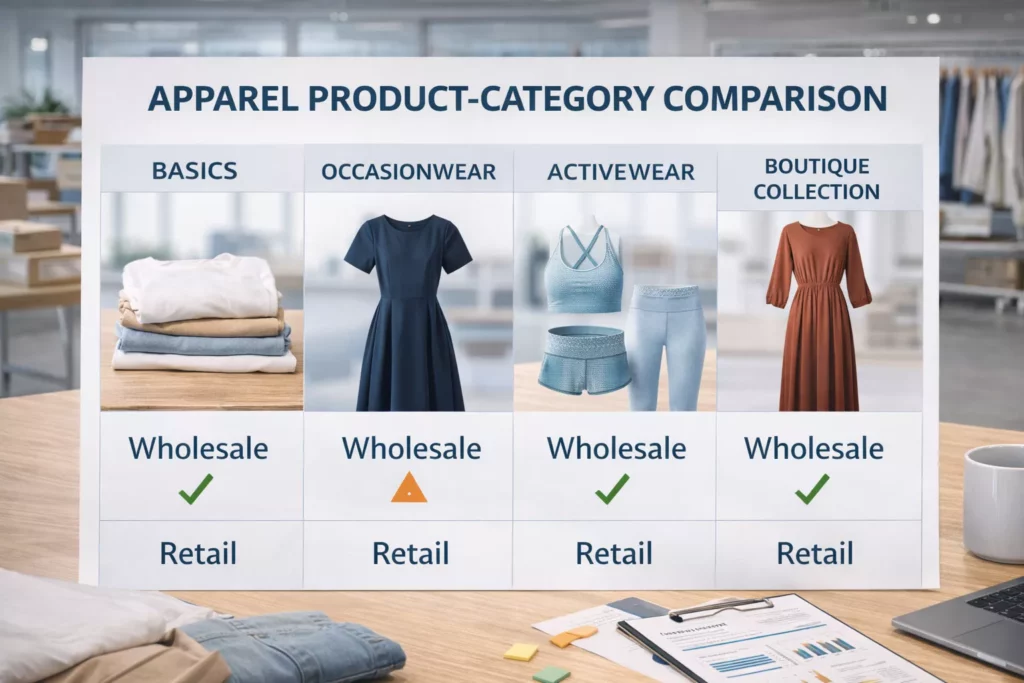
How Product Type Changes the Best Business Model
The type of clothing you sell can strongly influence whether wholesale or retail works better.
A highly branded premium basics label often performs well in retail because the product needs storytelling, fit explanation, and direct customer trust. A boutique occasionwear line may work very well in wholesale because store buyers are often looking for curated seasonal collections. Activewear may thrive in retail if the brand can build a strong content-led community, but it may also work in wholesale through fitness retailers or specialty accounts.
Some product types are easier to explain in direct retail, while others are easier to distribute through wholesale channels.
Ask questions like:
- Does the product need brand storytelling to sell?
- Does the customer usually discover this type of product in boutiques or online?
- Is fit education important?
- Is the product highly trend-driven or more evergreen?
- Would retailers understand how to merchandise it well?
The more your product relies on direct brand education, the more retail may help. The more it fits existing retail buying behavior, the more wholesale may make sense.
Cash Flow and Inventory Considerations
Both business models create inventory and cash flow pressure, but in different ways.
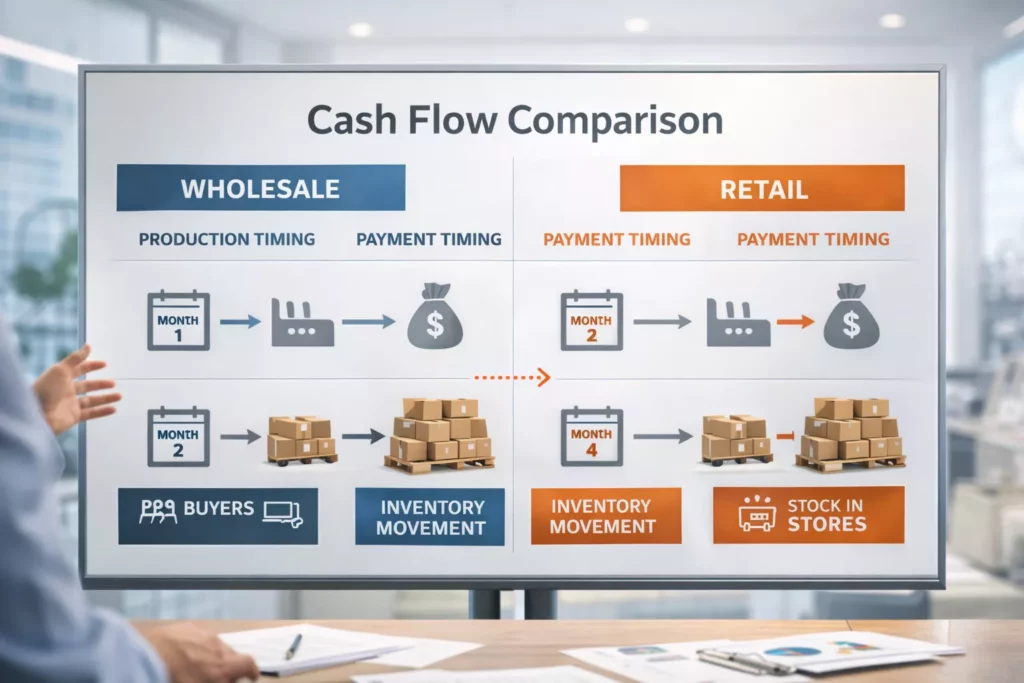
In wholesale, you may receive bigger orders, which helps move units faster. But you often need to finance production before receiving full payment, and if delivery expectations are strict, mistakes can become expensive quickly.
In retail, you may own more of the margin, but inventory may move slower because you are selling piece by piece. That means the brand must support customer demand generation continuously through content, ads, email, and community building.
Cash flow questions matter a lot here:
- Can you finance bulk production for wholesale?
- Can you survive slower sell-through in retail?
- How much inventory risk can you hold?
- How quickly do you need stock to convert into cash?
Some brands prefer wholesale because bigger orders make inventory movement more predictable. Others prefer retail because the long-term margin and customer ownership justify the slower movement.
The better model is often the one your current working capital can actually support.
Branding and Customer Relationship Differences
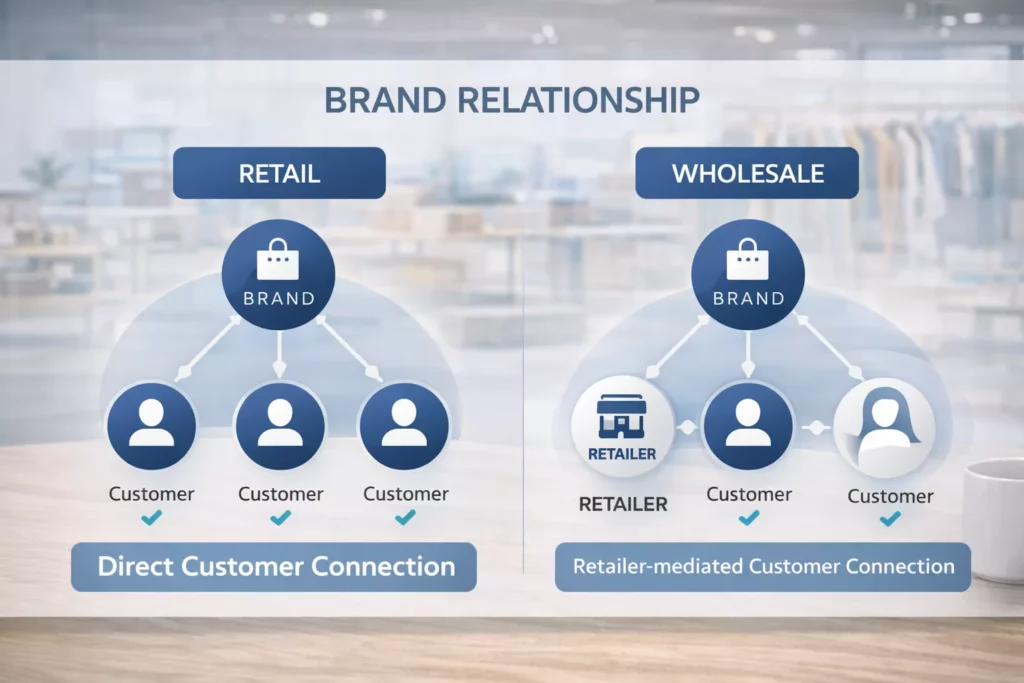
A retail clothing business usually builds a stronger direct relationship with the end customer. The brand controls the messaging, packaging, customer emails, product descriptions, and overall post-purchase experience. That gives retail brands more room to build loyalty and repeat purchase behavior over time.
In wholesale, the relationship is more indirect. The final customer may like the garment but remember the store more than the brand, especially if the brand identity is not strongly communicated at the point of sale. This does not mean wholesale brands cannot build recognition. It means they often need extra effort to stay visible through packaging, hangtags, product quality, and selective account placement.
If your long-term goal is to build a community-driven or identity-driven brand, retail often gives you better conditions for that. If your goal is more product distribution through retailer networks, wholesale may still be the better fit.
This is one of the most emotional but important parts of the decision. Are you trying to build a brand customers follow directly, or a product business that succeeds strongly through trade relationships?
Marketing Requirements: Wholesale vs Retail
Retail and wholesale also demand very different marketing styles.
In retail, marketing is customer-facing. The brand needs content, ads, email flows, product storytelling, influencer or creator partnerships, retention strategy, and often strong ecommerce conversion systems.
In wholesale, marketing is often buyer-facing first. You may need:
- line sheets
- wholesale lookbooks
- trade outreach
- sales presentations
- buyer meetings
- wholesale trade shows
- retailer-ready merchandising support
This means a founder who is naturally strong in direct content and digital brand building may feel more comfortable in retail. A founder who is stronger in trade relationships, product presentation, and B2B sales may be well suited to wholesale.
Neither marketing system is easier. They are just different. One sells to customers directly. The other sells to businesses that then sell to customers.

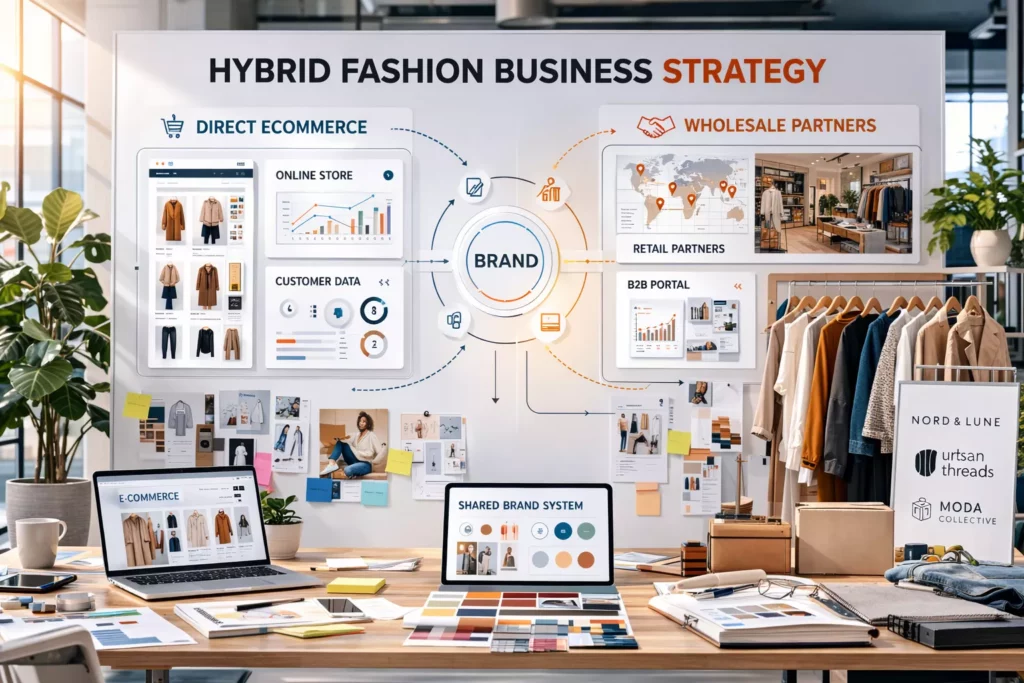
Can You Combine Wholesale and Retail?
Yes, and many successful clothing brands eventually do. A hybrid model can create balance by using retail for margin and brand control while using wholesale for reach and volume. But a hybrid strategy works best when the brand has enough operational maturity to manage channel differences properly.
Combining both models may allow a brand to:
- keep direct customer relationships through its own store
- place products in selected retail accounts
- diversify revenue sources
- increase brand visibility
- test categories across different sales environments
But hybrid models also require care. Price consistency becomes important. Inventory planning becomes more complex. Retail partners may react negatively if your DTC site constantly undercuts them. The brand must also decide which styles, launches, or exclusives belong in which channel.
A hybrid structure is often a strong long-term goal, but not always the best first move. Many brands do better by mastering one channel first, then adding the second with intention.
Signs Wholesale Might Be Better for Your Clothing Business
Wholesale may be the better path if:
- your collection is highly boutique-friendly
- you already have retailer or buyer relationships
- your product line is easy to merchandise across stores
- your margins can support wholesale pricing
- your production is reliable and scalable
- you want larger order volumes rather than one-by-one selling
- you are comfortable with B2B sales and account management
It may also be a strong fit if your brand performs best through curated placement rather than direct digital storytelling. Some categories simply work very well when trusted stores introduce them to customers.
Still, wholesale is strongest when the brand is commercially disciplined. If the business struggles with lead times, quality consistency, or costing structure, wholesale can create pressure instead of growth.
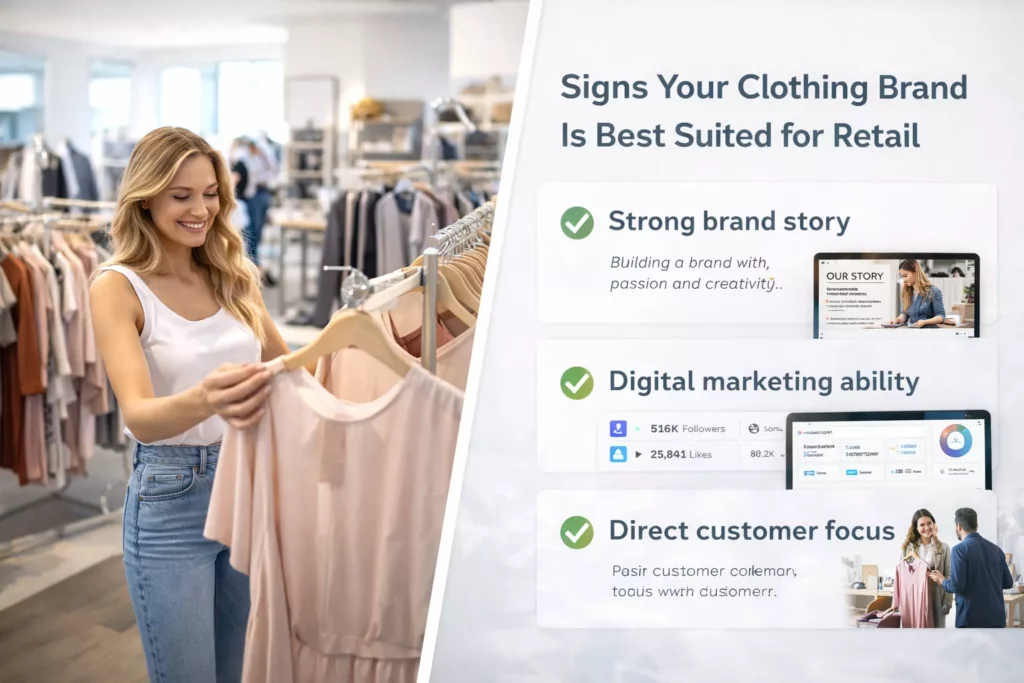
Signs Retail Might Be Better for Your Clothing Business
Retail may be the better path if:
- you want direct control over pricing and presentation
- your brand depends on story, fit education, or community
- you are strong in content and digital marketing
- you want direct customer data and repeat sales potential
- you are launching small and testing product-market fit
- you want long-term brand equity under your own control
- your product needs more explanation than a retailer may provide
Retail is often ideal for founders building niche, premium, or identity-led brands that need direct communication. It is also useful when the brand is still learning and wants immediate market feedback.
But retail requires patience and operational effort. It rewards founders who are willing to build traffic, improve conversion, and strengthen customer experience over time.
How to Decide Which Model Is Better for You
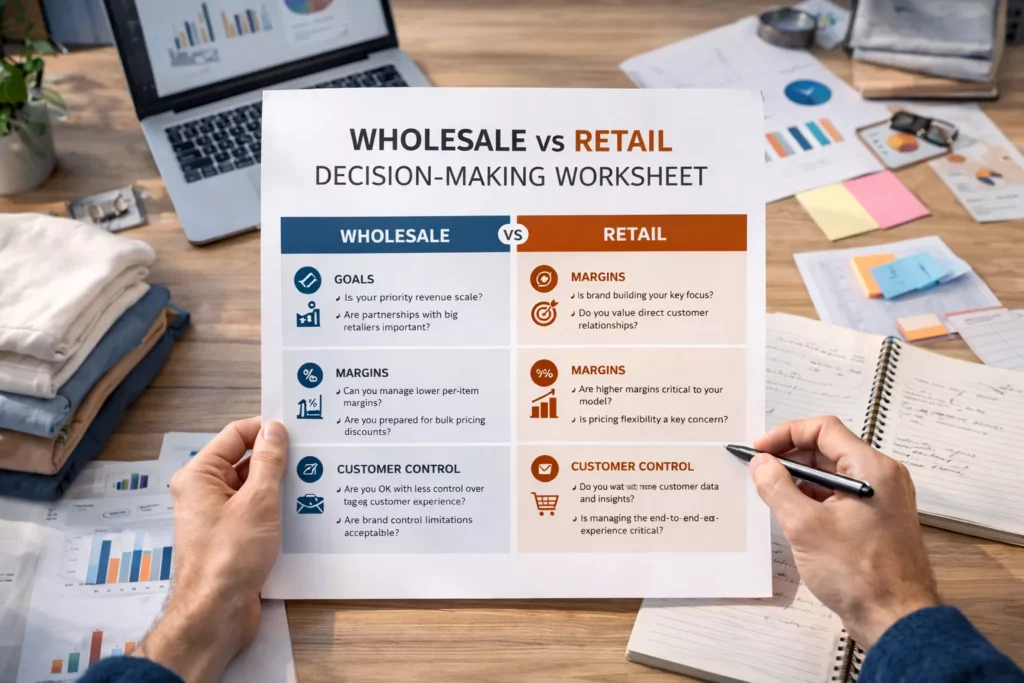
If you are still unsure, use a simple decision framework.
Ask yourself:
- Where will my product sell most naturally?
- Do I want customer ownership or distribution leverage first?
- Can my margins support wholesale?
- Can I handle direct customer acquisition in retail?
- Is my brand strong enough to sell direct?
- Is my production stable enough for wholesale deadlines?
- What channel matches my current budget and team?
The better model is usually the one that matches your current stage, not your final dream. You can always evolve later. A retail-first brand can grow into wholesale. A wholesale-led brand can strengthen DTC later. What matters is that the first model fits your product, your cash flow, and your actual ability to operate it well.
Clarity beats ambition here. A focused model executed properly is better than trying to do both badly.
Navigating the Dynamics of Wholesale and Retail Pricing
Navigating pricing starts by asking what’s the difference between wholesale and small-scale selling: wholesale involves bulk distribution where wholesale is the process of buying large quantities at lower per-unit costs so stores profit from volume, whereas retail refers to selling individual items through retail outlets or online channels. In contrast, retail transactions focus on consumer experience, and in ecommerce retail pricing must factor in shipping, returns, and platform fees. For businesses choosing between wholesale and direct-to-consumer, consider margins, inventory risk, and brand control: wholesale refers to giving up some pricing power for faster turnover, while wholesale is the ability to move volume quickly. If you prefer tighter margins but broader reach, the right wholesale model helps scale; if you value margins and customer data, retail might suit better. Review retail faqs to understand the evolving retail landscape and pick the best route.
ApparGlobal
Many apparel brands make stronger channel decisions when they work with manufacturing partners that understand pricing structure, MOQ planning, product development, and scalable production. Companies such as ApparGlobal help clothing brands align garment specifications, costing logic, production workflows, and channel strategy so wholesale and retail growth become more practical, more organized, and more profitable from the beginning.

Conclusion
So, wholesale vs retail clothing business: which is better? The real answer is that neither model is automatically better in every case. Wholesale can offer larger-volume orders, wider distribution, and access to existing retail audiences, but usually with lower margins and less brand control. Retail can offer stronger margins, direct customer relationships, and long-term brand ownership, but it also demands more marketing, fulfillment, and customer-facing operational effort.
For many startup clothing brands, retail is often the easier place to learn because it creates direct feedback and stronger control. For product-driven brands with strong buyer relationships and commercial discipline, wholesale can also be a highly effective growth model. And for more mature brands, a hybrid strategy may eventually offer the best of both. The better model is the one that matches your product, pricing structure, production